The Vision
In 1924, a few months before any proposal emerged for him to travel to England, Hazrat Mirza Bashir-ud-Deen Mahmood Ahmad (may Allah be pleased with him) saw himself in a profound vision standing on the shores of England.
He was dressed in military attire, as a general who had just achieved victory. A thick wooden beam lay on the ground. One foot rested upon it, the other on the earth, as a commander might stand when surveying conquered territory from an elevated position.
His body felt unusually light and agile, the way one feels after extraordinary success. He looked in every direction with the keen eye of a seasoned strategist, pondering how to derive the greatest benefit from this conquest, considering whether any front still required attention.
Then came a voice. He perceived it as his own, as if he and the speaker were one being. It proclaimed three words:
“William the Conqueror.”
He immediately related this vision to his companions, including Hazrat Mufti Muhammad Sadiq, who consulted an English dictionary and discovered that “William” derives from Germanic roots meaning “one of firm resolve” or “steadfast in determination.”
In Arabic, this translates to Ulul-Azm – a man of high resolve. The phrase “William the Conqueror” could thus be understood as “A Conqueror of Firm Resolve,” a title befitting one destined to plant the flag of Islam in lands far from its birthplace. [Khutbat-e-Mahmood, vol. 8, pp. 537-538]
This connection to Ulul-Azm was no coincidence. In the original prophecy of February 20, 1886, and in subsequent revelations, Allah had told the Promised Messiah (peace be upon him) that this son would be “Ulul-Azm [a man of high resolve]” and his “likeness in virtue and benevolence.” [Tadhkirah, English translation, p. 210, 2018 ed.]
The vision of being called William the Conqueror thus confirmed in English what had been prophesied in Arabic and Urdu nearly four decades earlier: The Promised Son would indeed be one of firm resolve.
The Historical Parallel
The historical William the Conqueror, who was Duke of Normandy, crossed the English Channel in 1066 and defeated the Anglo-Saxon forces of Harold Godwinson at the Battle of Hastings.
His victory brought about the most significant transformation in English society ever witnessed. He replaced the old Saxon aristocracy with Norman nobles, introduced centralised governance where feudal chaos had reigned, commissioned the Domesday Book as a comprehensive census of the realm, and built architectural monuments—including the Tower of London—that stand to this day.
Every subsequent English monarch has descended from him. He did not merely conquer territory. He reshaped a civilization.
The parallels to Hazrat Musleh-e-Mau’ud’s (may Allah be pleased with him) spiritual mission are striking.
Just as William crossed the English Channel to bring profound and lasting change to a land previously unfamiliar with Norman civilization, Hazrat Musleh-e-Mau’ud (may Allah be pleased with him) journeyed to England to introduce the true, pristine teachings of Islam to a Western world largely unacquainted with its message of peace and spiritual renewal.
William was an accomplished diplomat, gifted military commander, and determined ruler.
These qualities find their spiritual reflection in Hazrat Musleh-e-Mau’ud’s intellectual brilliance, organizational genius, and resolute commitment to the cause of Islam.
Moreover, just as every subsequent monarch in England has been of Norman descent, the seeds planted during the 1924 journey would bear fruit for generations, culminating in the establishment of thriving Ahmadiyya communities across the Western world and, eventually, the permanent residence of Khilafat in London from 1984 onwards.
The Khalifa of Firm Resolve in England
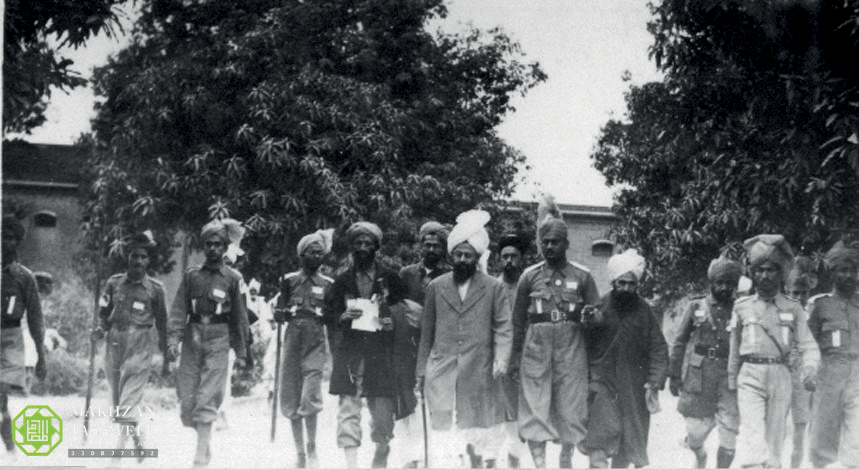
He travelled to England to attend the Conference on Some Living Religions Within the Empire at Wembley, becoming the first Khalifa of the Promised Messiah (peace be upon him) to leave the Indian subcontinent.
On October 19, 1924, he laid the foundation stone of the Fazl Mosque in London, the first purpose-built mosque in the British capital. British dignitaries and diplomatic representatives attended the ceremony.
What William had achieved through military force, the Promised Son would achieve through spiritual conquest.
Yet the vision contained a caution. As Hazrat Musleh-e-Mau’ud (may Allah be pleased with him) himself noted, the results of this spiritual conquest might not appear immediately. “It is possible that the seed is sown during the journey and the result emerges later.”
History confirmed this interpretation. The work began in 1924 and established the foundations for the global expansion of the Ahmadiyya Muslim Community that continues today across more than 210 countries.
The title William the Conqueror spoke to his outward mission. Another spiritual title, revealed years earlier, spoke to his relationship with his esteemed father and the internal structure of their complementary roles.
A Parcel Addressed to Two Names
During the lifetime of the Promised Messiah (peace be upon him), the young Mahmood Ahmad experienced a vision in which someone handed him a parcel, saying it contained something for him and something for the Promised Messiah (peace be upon him).
When he examined the address, he found two names written:
“Muhyud-Deen” and “Mu’een-ud-Deen.”
Initially, he thought Muhyud-Deen was referring to himself since he only associated this title with the Mughal emperor Aurangzeb. Furthermore, he assumed that Mu’een-ud-Deen referred to the Promised Messiah (peace be upon him) because Mu’een-ud-Deen Chishti was a highly renowned and respected saint in India.
Later, as he advanced in knowledge, the true meaning became clear.
Muhyud-Deen means “Reviver of the Faith” and refers to the Promised Messiah (peace be upon him), who had breathed new life into Islam.
Mu’een-ud-Deen means “Helper of the Faith” and referred to himself, destined to support and nurture what had been revived.
He explained this through a striking metaphor: “Just as a mother gives birth to a child and the wet-nurse nurtures it with milk, so too did the Promised Messiah (peace be upon him) give birth to the revival, and I am the one who helped and supported the faith.” [Khutbat-e-Mahmood, vol. 25, pp. 89-90]
To understand this relationship fully, one must grasp what the Promised Messiah (peace be upon him) claimed to have revived.

Reviver of the Faith
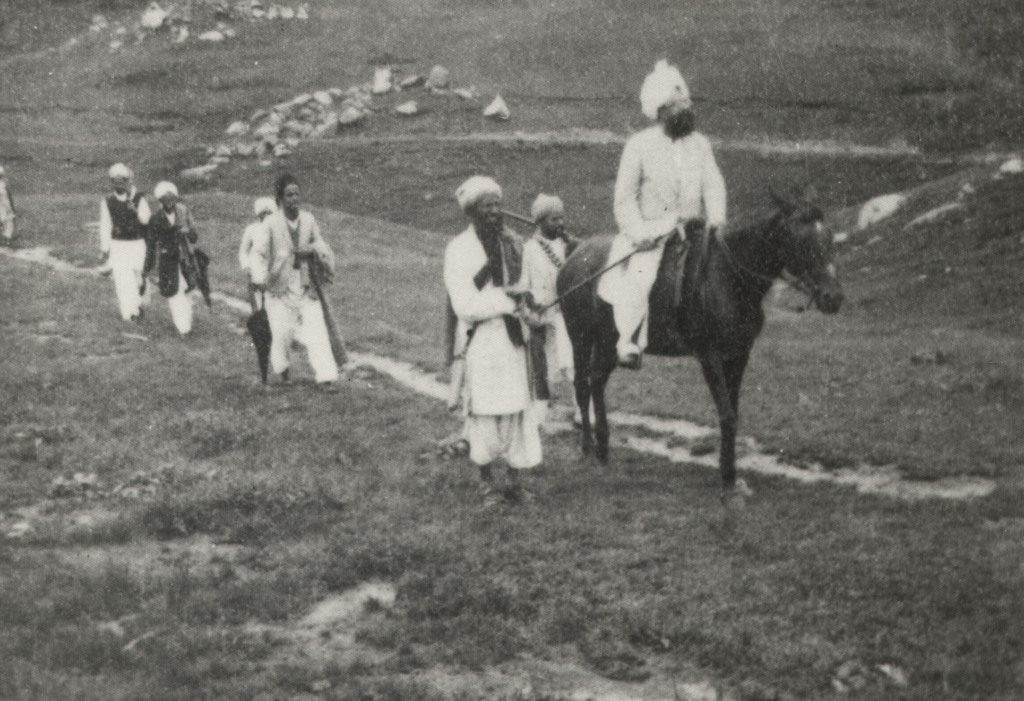
Hazrat Mirza Ghulam Ahmad of Qadian (peace be upon him) declared, under divine guidance, that he was the Promised Messiah and Mahdi, sent to revive the mission of the Holy Prophet Muhammad Mustafa (peace and blessings of Allah be upon him).
Everything he did was an act of love and service toward his Master. His goal was not to establish a new religion but to restore Islam to its original teachings and unite humanity under the flag of the Holy Prophet (peace and blessings of Allah be upon him).
The Promised Messiah (peace be upon him) was Muhyud-Deen precisely because he revived what the Holy Prophet (peace and blessings of Allah be upon him) established fourteen centuries earlier.
Helper of the Faith
The role of Mu’een-ud-Deen was therefore to help this revival reach its full potential. A reviver plants the seed. A helper waters it, tends it, and ensures it grows into a mighty tree whose branches extend across the earth.
The metaphor of the wet-nurse, however, deserves careful reflection. A mother’s role, though foundational, centers on bringing forth life. The wet-nurse’s role is ongoing, daily, and sustaining. It is the patient work of nourishment that transforms a helpless infant into a thriving adult.
The Promised Messiah (peace be upon him) revived the true teachings of Islam and established the Ahmadiyya Muslim Community in 1889. But it was Hazrat Musleh-e-Mau’ud (may Allah be pleased with him) who built the Nazarat system that gave this Community administrative coherence.
It was he who established Tahrik-e-Jadid in 1934 and Waqf-e-Jadid in 1957, financial mechanisms that transformed scattered donations into sustained global missionary efforts. In 1934, the initial call for 27,500 rupees under Tahrik-e-Jadid yielded 103,000 rupees from a community facing persecution and poverty. By 1953, Tahrik-e-Jadid had become the financial engine for establishing missions in 46 countries.
It was he who founded the auxiliary organizations. Lajna Ima’illah for women in 1922. Khuddamul Ahmadiyya for young men. Ansarullah for middle-aged to elderly men. Atfalul Ahmadiyya for children and Nasiratul Ahmadiyya for young girls. Each organization was designed to train every segment of the Community in service to the faith.
When Hazrat Musleh-e-Mau’ud (may Allah be pleased with him) arrived in Rabwah in 1948, leading refugees to an arid wasteland after the partition of India, he was not establishing a new religion. He was ensuring the survival and growth of what his father had established.
When he dispatched missionaries to Africa, Europe, and the Americas, he was not proclaiming a new message. He was carrying his father’s message to lands that had never heard it. When he penned the 5,907 pages of Tafsir-e-Kabir, he was not revealing new scripture. He was illuminating the depths of the Holy Qur’an so that new generations could drink from its wisdom.
This is the work of Mu’een-ud-Deen. Not to originate but to amplify. Not to found but to fortify. Not to create the message but to carry it to the corners of the earth.
Filled With Knowledge
His intellectual output defied the limitations of his formal education. Chronic eye problems had ended his schooling at the primary level. Yet his Qur’anic commentary drew from major Arabic lexicons and engaged with modern science, orientalist criticism, and contemporary social issues. Recent discoveries by the Fazl-e-Umar Foundation have uncovered additional unpublished material that is said to be more than twice the size of the published commentary. The boy who could hardly read without pain produced enough theological writing to fill a library.
Inhabiting the Inhabitable
The partition brought catastrophe. Qadian, the birthplace of Ahmadiyyat, fell on the Indian side of the border, while most Ahmadi Muslims found themselves in Pakistan.
At 58, Hazrat Musleh-e-Mau’ud (may Allah be pleased with him) had to rebuild from nothing. He personally surveyed potential sites for a new headquarters, analyzing water sources, transportation links, and agricultural potential.
On September 20, 1948, he led the first convoy to what observers described as arid and mountainous land. Within a decade, Rabwah had a school, a college, a hospital, and the administrative infrastructure of a global religious movement.
“I am astonished,” he reflected in 1961, “as to what was the force that brought and inhabited you in a place which even the Government had failed to habitat.” He compared it to Prophet Abraham rebuilding Makkah in the desert with his son Ishmael (peace be upon them).
The prophecy announcing the Promised Son spoke of one “filled with secular and spiritual knowledge” whose “fame will spread to the corners of the earth.”
The first prediction seemed impossible for a child who could not pass elementary school. The second seemed improbable for a leader of a persecuted minority sect in colonial India’s periphery.

Spreading of His Fame
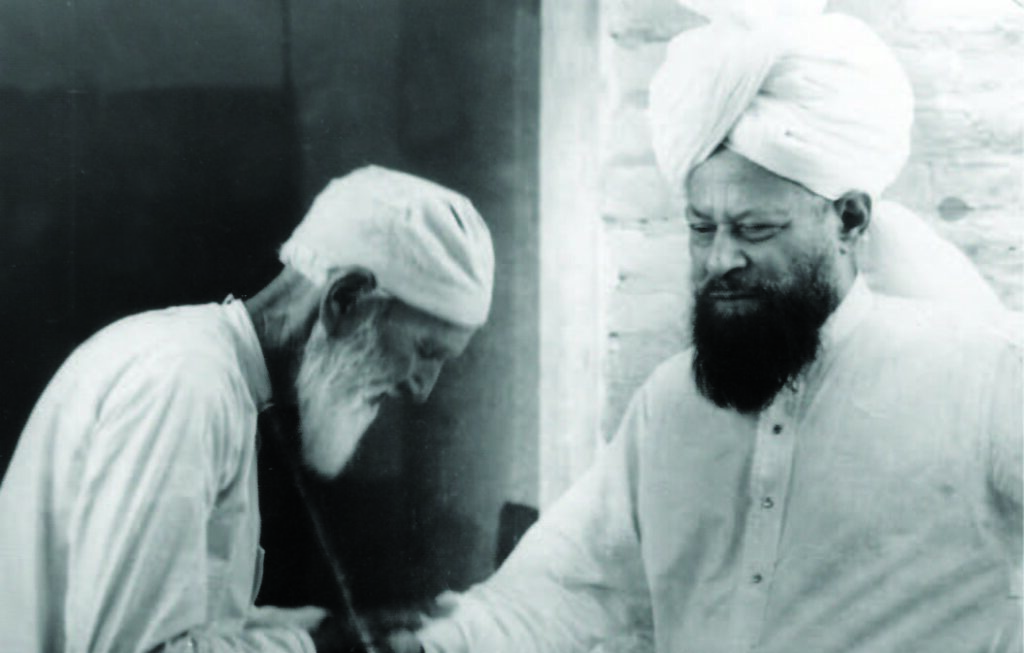
But the title Mu’een-ud-Deen specified how that fame would spread. Not through dramatic acts of revival, for that was his father’s role, but through the steady, systematic work of helping, supporting, nurturing, and building. Every institution he created, every organization he founded, every book he authored, every missionary he trained was an act of assistance to the faith.
Both predictions proved true, revealing a pattern woven throughout his entire story. Physical limitations fostered spiritual growth. Educational constraints spurred intellectual breakthroughs. Persecution ignited global expansion.
The boy who could not see the blackboard authored thousands of pages of Qur’anic commentary. The leader of a small community in rural Punjab founded missions across six continents. The refugee who was driven out of Qadian built Rabwah from desert soil.
The two titles work together. Mu’een-ud-Deen describes his relationship to what came before, the helper who nurtured his father’s revival of the Holy Prophet’s mission.
William the Conqueror describes his relationship to what lay ahead, the spiritual general who would plant the flag of Islam in lands far from its birthplace.
One title looks backwards to the chain of prophecy connecting him to the Promised Messiah (peace be upon him) and through him to the Holy Prophet Muhammad (peace and blessings of Allah be upon him). The other looks forward to the global community that would emerge from his labours.
From Qadian to the Corners of the Earth
Today, the Ahmadiyya Muslim Community is established in over 210 countries. The institutions he built continue to train new generations. The financial schemes he launched continue funding missions. The administrative structures he created continue to coordinate work across continents.
The impossible has become inevitable. The boy with failing eyes built a vision that spans the globe. And at the foundation of this global structure lies the work of Mu’een-ud-Deen, the Helper of the Faith, who took what was born in Qadian and carried it, exactly as prophesied, “to the corners of the earth.”
Fazal Masood Malik Sahib is a regular contributor to the Ahmadiyya Gazette Canada and is currently serving as Sadr Jama’at, Prince Edward Island.