


Editor’s Note
The September/October 1928 issue of The Review of Religions featured a faith-inspiring eyewitness account from the blessed era of Hazrat Mirza Ghulam Ahmad, the Promised Messiah and Mahdi (peace be upon him). This account was penned by Hazrat Maulawi Sher Ali (may Allah be pleased with him), a devoted companion of the Promised Messiahas and translator of the Holy Qur’an into English.
Ahmadiyya Gazette Canada is honoured to reproduce this historic article. To maintain its authenticity, salutations have not been included in this reproduction, and apart from minor typographical edits, no modifications have been made to the text. Readers are encouraged to say the appropriate salutations at the mention of holy personages. For the convenience of readers, a brief glossary is given at the end.
In the beginning of his career, when Ahmad sounded his trumpet-call to the nations of the earth, he was a solitary man, little known to the outside world. When, however, his first publication, the “Barahin-i-Ahmadiyya,” appeared, he began to make a name in the world and visitors from outside stations came to see the wonderful author of the wonderful book. But as Qadian was an out-of-the-way village, such visitors were only few and far between. Whenever such a visitor came to him, he found the days of his stay at Qadian to be the happiest days of his life and was loth to part with him.
When I came to Qadian in the year 1897, I found a writing on a wall of the Jami-Mosque of the village. It was by Qazi Zia-Ud-Din of Qazi Kot, Gujranwala district, father to our present Head Master, Qazi Abdullah, B.A., B.T., formerly Muslim Missionary in London. If I remember aright, it bore the date of 1885 and was to the following effect:
“If it had not been for my mother who is old and infirm at home, I should have never quitted the company of Hazrat Mirza Sahib. The words of the poet, ‘Suhbate ba’d az liqae to haram’ (‘It is unlawful to seek any other company after meeting thee’), were never more truly applicable to anybody than they are to him.”
I have quoted the above words to show how those who came in close contact with Ahmad were attracted to him by love. I may also quote here what the same gentleman said to me years after he inscribed the above writing on the wall. This gentleman became so devoted to his master that, like many others, he left his home for good and emigrated with his children to Qadian, to enjoy uninterruptedly the bliss of his master’s company and to make his children also to partake of the blessings of a life at Qadian. He told me that one day, when he was sitting with his master, he thus addressed him: “My lord, I feel contradictory desires rising in my heart. On one hand, I earnestly desire that Your Exalted Holiness’s truth and spiritual charms may soon become known to the outside world and men from all races and creeds may come and drink at the fountain which God has caused to flow here; but simultaneously with this desire, the thought pains my mind that when others will also come to know Your Exalted Holiness and will begin to come here in large numbers, I shall be debarred from the pleasure of enjoying the close company as I do now. Your Exalted Holiness will, then, be surrounded by others and I shall be deprived of the happy privilege of sitting close to my beloved master and talking with him. Such are the contradictory desires which rise alternately in my breast.” The Qazi Sahib added, that when the Promised Messiah heard these words, he smiled.

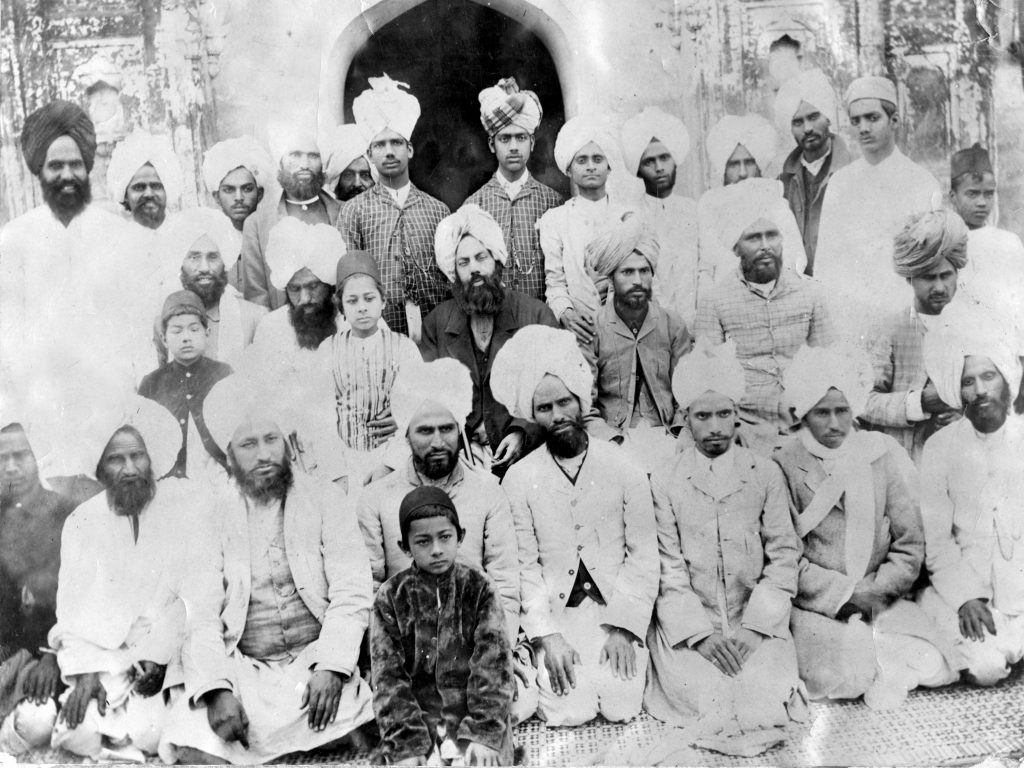
The Promised Messiah (peace be upon him) is seated on a chair in the middle. Hazrat Qazi Zia-ud-Din, may Allah be pleased with him, is seated on the ground, second from the left.
The fears and desires of that old and venerable disciple of Ahmad, however, soon began to be realised. For when, in the year 1891, Ahmad, at the bidding of his Lord, announced his claim to Promised Messiahship, then, although there arose a storm of opposition against him from all sides, yet many thoughtful persons, considering the sanctity of his past career, the force of his arguments and the divine character of the heavenly signs which God showed at his hands, accepted him. As the evidence of his truth accumulated with the lapse of time and men saw more and more prophecies of his turning out true, they flocked round him in large numbers, and many of them, like their brethren, the disciples of Jesus, left their homes to live in his company day and night. When I first came to Qadian on the eve of the memorable “Id” which was followed by the fulfilment of that great prophecy of Ahmad relating to the woeful end of Pundit Lekh Ram, the Arya preacher, viz., on the 5th of March, 1897, I saw that many had already adopted Qadian as their home.
Of the early emigrants to Qadian, two were most noteworthy. One was Hazrat Molvi Hakim Haji Noor-ud-Din, of Bhera, who afterwards became the first successor to the Promised Messiah on the death of the latter. He was a man of great learning, and before his coming to Qadian he had already acquired in the learned circles, not only in India, but also abroad, a great reputation for his vast scholarship and able championship of Islam. The other was Molvi Abdul Karim, of Sialkot. He was also a very learned man and had devoted his life to the service of Islam. For some time he had been an adherent of the Aligarh School of thought, the school of Sir Syed Ahmad Khan, but soon he came over to Ahmad of Qadian. He, too, like his friend Hazrat Molvi Noor-ud-Din, adopted Qadian as his home. He had a very beautiful voice and recited the Holy Quran in the most charming manner. It was he who generally led the five prayers, including the Juma prayers. He was an eloquent speaker. He was a man of keen intelligence, as the reader may judge from his booklet, “A Character Sketch of Ahmad,” an English Translation of which has already been published for the benefit of Western readers, which is also prefaced with a brief account of his life.
There was a large number of other persons also, many of them with families, who had emigrated to, and settled at, Qadian.
The Promised Messiah used to exhort his followers to come to him as often as possible, so that they might benefit by his company. Hence there was always a number of visitors at Qadian, some of them staying for months.
The Promised Messiah used to dine with his guests, both in the morning and evening, the small mosque attached to his house being used as the dining room, and he continued this practice till a few years before his death, when the condition of his health and the increased number of visitors precluded his doing so. Thereafter the guests had their meals in the “Mehmankhana,” or the guest-house.
The Promised Messiah used to say his five daily prayers with the congregation in the small mosque adjacent to his house. He seldom led the prayers personally, one of his followers always acting as the Imam.
Following was generally the daily routine of life. The Promised Messiah was in the habit of having a constitutional walk daily in the morning. He was then accompanied by his followers present at Qadian. The next time when his disciples were able to enjoy his company was the time between Zuhr and Asr prayers (i.e., generally from 2 to 4 p.m.), when he stayed in the mosque after saying the Zuhr prayers. Similarly, he sat among his disciples after performing the Sunset prayers. The remaining time the visitors spent either in the Mehmankhana, or in the company of Hazrat Molvi Noor-ud-Din in his Matabb, where he treated his patients and also gave his lectures on Islamic and other books, or with Molvi Abdul Kareem in the small mosque. The time between Asr and Maghrib (Sunset) prayers was spent by the visitors in listening to the lectures on the Holy Quran by Hazrat Molvi Noor-ud-Din in the Jami-Mosque.
When in the company of the Promised Messiah, either during the morning walks, which were usually fairly long, or in the small mosque where he sat after saying his noon or sunet prayers, the topics of conversation were of miscellaneous character. When sitting in the mosque, the Promised Messiah occupied no prominent position, so that it was often difficult for a stranger to know him from his disciples. The first thing which his disciples were fond of hearing from his sacred lips was some fresh revelation. These revelations generally contained prophecies, and their fulfilment in due time added to the faith of his disciples, hence their eagerness to listen to them. These revelations were also published in papers for the information of the public, including his disciples living away from Qadian; and if there was a prophecy of particular importance, the Promised Messiah published it by means of posters or handbills which were widely circulated throughout the country. These revelations were also embodied in the books which he happened to be writing at the time.
Very often his followers put questions to him on some religious subjects, desiring to be enlightened on them, and his answers generally developed into a short speech. Occasionally, he received visits from enquirers or tourists who put him questions about his claims and the evidence in support of them, and some of them even spoke to him rudely, but he always answered them calmly and dispassionately, and even restrained his disciples from showing anger at their rude language. There once came a young Arab from North Africa, probably from Morocco. He was barefooted and very simple in his habits and dress. When the Promised Messiah went out for his morning walk that day, the new visitor met him and without any ceremony asked him very indignantly how he could be the Messiah and Mahdi, and added that it was certainly very preposterous on his part to make such claims. The Promised Messiah explained to him the nature of his claims and cited evidence in their support, but even more than an hour’s discussion left him unconvinced. He appeared to be a sincere, straightforward man, and the Promised Messiah received a revelation urging him both to pray for him and to continue his argument with him. Encouraged by this revelation, the Promised Messiah began to pray for him and continued to lecture him during his daily walks. These ended in his conversion, and the indignant Arab became a sincere believer and a devoted disciple. He wrote and had printed a poster in Arabic, setting out therein the arguments of the truth of the Promised Messiah, purchased a number of Ahmad’s Arabic works, and started on his way back home, promising to preach Ahmad’s message to his countrymen. We have, however, never heard from him since then. He was offered some money for the expenses of his journey, but he declined to take even a pie. I remember having seen him walking barefooted to the Batala Railway Station, a distance of eleven miles, carrying on his shoulders the bundle of books and posters which he had taken from Qadian.

Sometimes, when in Ahmad’s company, his disciples recounted to him how they were persecuted in their respective villages or towns, how the enemies of the Promised Messiah had laid them under a ban, how they were not allowed to draw water from their wells, how by all means in their power they had made their lives intolerable to them. The sons related how their fathers shut them up in their houses, bound them hand and foot and thrashed them, calling upon them to renounce their faith in the Promised Messiah, and even abuse him. Some of them related how they were implicated in false cases, and how false testimonies were borne against them in the courts of justice, to get them punished.
Some of his young disciples related to him how they had been dispossessed of all their belongings, even stripped of their clothes and turned out of their homes. His disciples told him how the moulvies had pronounced them to be Kafirs whose marriage with their lawfully wedded wives had become null and void, so that anybody might take and marry them. In short, various were the forms of persecution to which they were subjected and which they related to their master with tears in their eyes. Some of them said that when, on their way to Qadian, they halted at such and such a village and entered the village mosque to shelter themselves from the frosty cold of a wintry night, the mullah of the village, on learning that they were on their way to Qadian, turned them out of the mosque, hungry and shivering with cold. To such the Promised Messiah said that when questioned as to their destination, they should never conceal from the bigoted mullah or his fanatical followers that they were coming to Qadian. That would serve as an advertisement, and the mullahs would come to know how, in spite of their bitter opposition, the movement was spreading far and wide.
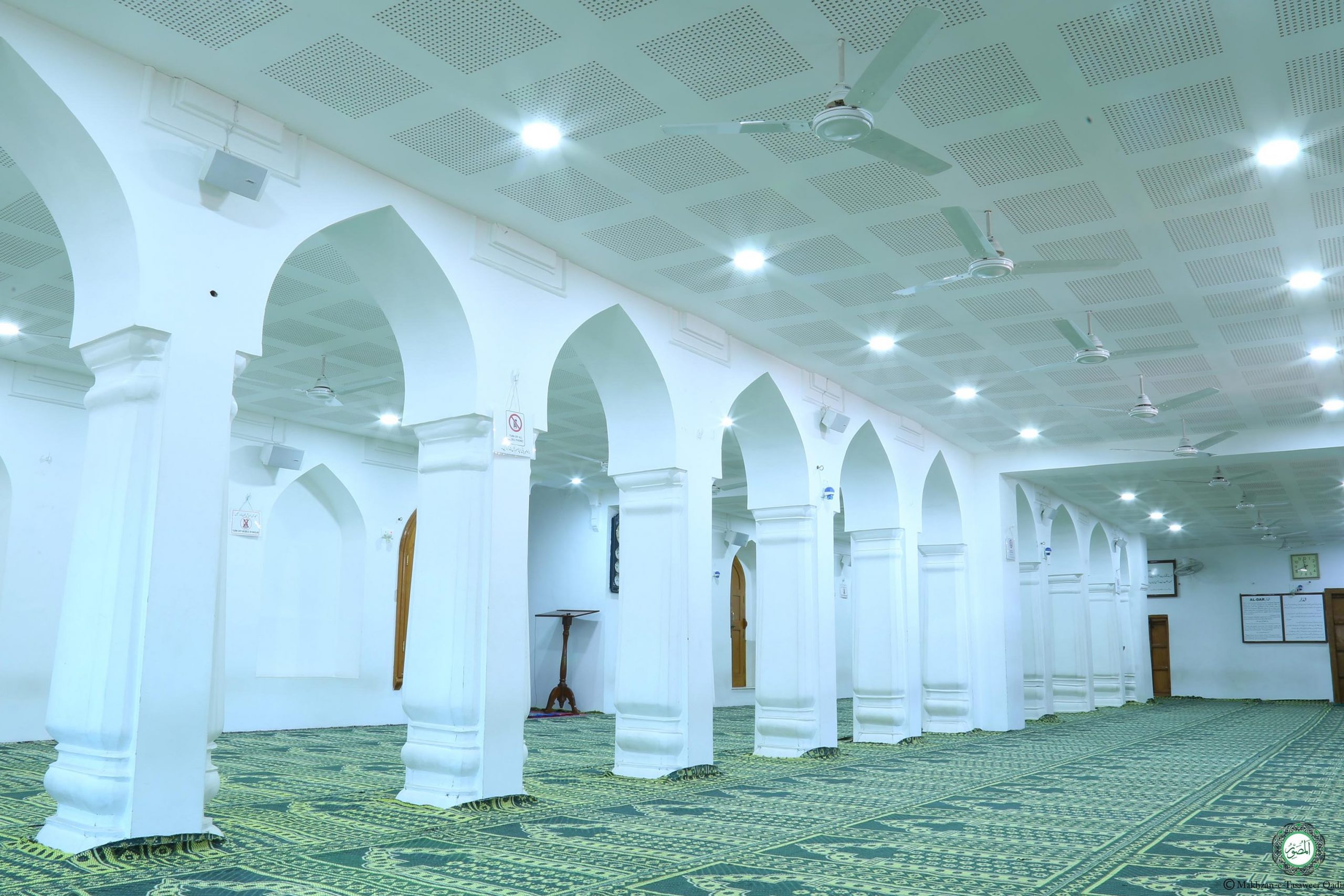
The disciples of Ahmad coming to or residing at Qadian were not exempt from this persecution on the part of his enemies. Once, for instance, the way to the mosque where his followers said their five daily prayers in company with their master, and to which they also came regularly to offer their Tahajjud (Midnight) prayers during the small hours of the night, was blocked by the erection of a big wall near the entrance of the mosque, and the worshippers had to take a long and roundabout way in order to reach the mosque. This wall was raised by the cousins of the Promised Messiah merely to cause annoyance to him and his followers, and it was only after the institution of legal proceedings against the culprits that the wall was demolished by order of the court.
The disciples of Ahmad residing at Qadian were harassed in other ways also. It was not only the Mussalmans, but also the Sikhs and Hindus who did their worst to put them to trouble. The villagers went so far as not to allow them even to ease nature in their fields a form of persecution which suggested itself only to the base inhabitants of Qadian. Similarly, they did not allow them to build houses for their residence, and prevented them from digging mud from the village ponds, and snatched away their spades with which they dug the earth.
When in the company of the Messiah, his disciples would sometimes relate how the vengeance of God had overtaken such of his opponents as had insulted him, and how God had verified the truth of His revelation, which said, “Inni Muhinun man arada ihanataka” (“I will disgrace him who will seek to disgrace thee”). They all testified to the fact that the promise contained in the above revelation invariably came out true, as an infallible law of God; and related various stories of how all those who had used an insulting language about the Promised Messiah or had sought to disgrace him in one way or another had without fail themselves met with disgrace.
Sometimes they would relate to him accounts of the debates and discussions with the moulvies, and these accounts were generally very interesting. In those days, the Promised Messiah had no regular missionaries. Every one of his disciples acted as a missionary and was always engaged in discussions with his neighbours, who asked him what had led him to accept the new claimant. Sometimes his disciples, when enjoying the company of their master, recited to him poems of their own composition, which were generally in Punjabi and dealt with the signs of his truth, particularly the prophecies which they had seen fulfilled with their own eyes.
The subjects on which the Promised Messiah generally addressed his followers in the course of these sittings pertained either to the evidence of his own claims or the refutation of the objections against Islam and an exposition of its beauties, or to a critical review of other faiths. Very often he exhorted his disciples to lead holy and pure lives and told them how they could enjoy special divine protection against the manifold visitations of God which had come upon the earth, in fulfilment of his own prophecies as well as those of the Prophets of yore. He said his times were like the days of Noah and only those could escape the tribulation of those days who would embark on his Ark, which was not made of wood and iron, but of the teachings which he gave to his followers. These teachings he later embodied in a small book which he published for the guidance of his followers and which he named the Noah’s Ark in allusion to the fact that those who would faithfully act upon those teachings would enjoy the special protection of God and would be held as his real followers in the sight of God. These teachings were translated into English and are now published under the title of the “Teachings of the Promised Messiah,” and the reader would do well to get a copy of these teachings and see for himself what sort of life he wished his followers to lead and whether it would not be proper for them to take those teachings as a model for their every-day life. In fact, if they take the noble teachings of Ahmad as a model for them, and try to act up to them, they will lead a life of angels on this earth.
[The Review of Religions, September/October 1928, pp. 26–31]
Glossary
Id: Eid
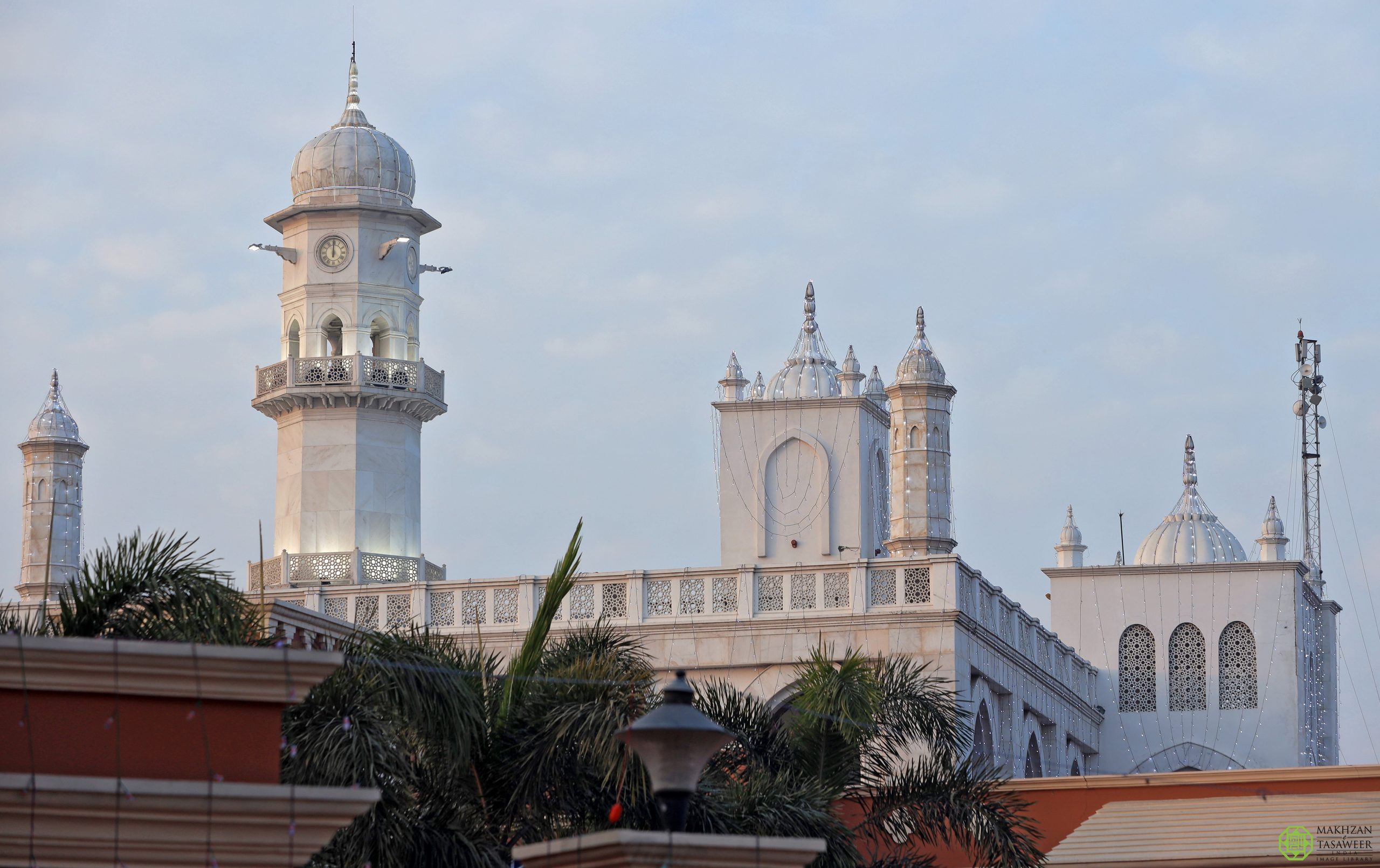
Jami-Mosque: lit. central mosque; in this article, it refers to Masjid Aqsa in Qadian
Kafirs: disbelievers
Matabb: medical clinic
Mehmankhana: guest house
Moulvies: Muslim clerics
Mussalmans: Muslims
Pie: a penny
Sunet: Sunnah prayer


