


Challenger Deep. 35,876 feet below sea level. 6.8 miles under the surface. The deepest point on Earth. In 2012, world-renowned filmmaker James Cameron descended into the Mariana Trench. He expected to see strange aquatic life, but instead encountered only pitch-black darkness.
Expert divers who go to the depths of the ocean with oxygen tanks have attested to the fact that it is so dark past 1,000 meters that one cannot even see their own hand. Scientists have classified three layers of the ocean’s water. The euphotic zone is the first layer, extending up to about 200 meters, where sunlight reaches. The second layer, called the dysphotic zone, ranges from about 200 to 1,000 meters. Minimal light penetrates this dimly lit zone. Beyond 1,000 meters, there is total darkness. This area is known as the aphotic zone.
This reality was first introduced by the Holy Qur’an 1,400 years ago. The Qur’an has prophetically described the darkness in the depths of the ocean in the following verse:
اَوْ كَظُلُمٰتٍ فِيْ بَحْرٍ لُّجِّيٍّ يَّغْشٰىهُ مَوْجٌ مِّنْ فَوْقِهٖ مَوْجٌ مِّنْ فَوْقِهٖ سَحَابٌ١ؕ ظُلُمٰتٌۢ بَعْضُهَا فَوْقَ بَعْضٍ١ؕ اِذَاۤ اَخْرَجَ يَدَهٗ لَمْ يَكَدْ يَرٰىهَا١ؕ وَ مَنْ لَّمْ يَجْعَلِ اللّٰهُ لَهٗ نُوْرًا فَمَا لَهٗ مِنْ نُّوْرٍؒ۰۰۴۱
Or their deeds are like thick darkness in a vast and deep sea, which a wave covers, over which there is another wave, above which are clouds: layers of darkness, one upon another. When he holds out his hand, he can hardly see it: and he whom Allah gives no light — for him there is no light at all. [24:41]
The Holy Prophet (peace and blessings of Allah be upon him) never travelled by sea. How could this unlettered man have known about the darkness in the depths of the ocean if not through divine revelation?
Hazrat Musleh-e-Mau’ud (may Allah be pleased with him) says:
“قرآن خدا کا قول ہے اور سائنس خدا کا فعل ہے”
“The Holy Qur’an is the Word of God, and science is His act.” [Mazhab aur Science, Anwarul-Ulum, vol. 9, p. 500]
Seven hundred and fifty verses of the Qur’an—almost one-eighth of the Book—urge believers to study nature, reflect, make the best use of reason in their search for the Ultimate, and incorporate the acquisition of knowledge and scientific understanding into the life of the community. Allah states:
اِنَّ فِيْ خَلْقِ السَّمٰوٰتِ وَ الْاَرْضِ وَ اخْتِلَافِ الَّيْلِ وَ النَّهَارِ لَاٰيٰتٍ لِّاُولِي الْاَلْبَابِ
In the creation of the heavens and the earth and in the alternation of the night and the day there are indeed Signs for men of understanding. [3:191]
Moreover, the Holy Prophet (peace and blessings of Allah be upon him) enjoined the acquisition of knowledge, as he said:
طَلَبُ الْعِلْمِ فَرِيضَةٌ عَلَى كُلِّ مُسْلِمٍ
“Seeking knowledge is a duty upon every Muslim.” [Ibn Majah, Hadith 224]
The Islamic Golden Age is a testament to this. Ibn Sina, Ibn al-Haytham, Ibn Khaldun, Al-Biruni, Ibn Rushd, and many other Muslim scientists made monumental discoveries in philosophy, mathematics, astronomy, medicine, and other fields. Therefore, it is clear that the Holy Qur’an never prevents one from increasing their knowledge of the world. Instead, it expands the mind’s understanding of the complexities and hidden truths of the universe. Over time, we see how these verities have become clear to mankind.
The Creation & Expansion of the Universe
Fourteen hundred years ago, the Holy Qur’an foreshadowed the cataclysmic event of the Big Bang as well as the existence of black holes. Allah says:
اَوَ لَمْ يَرَ الَّذِيْنَ كَفَرُوْۤا اَنَّ السَّمٰوٰتِ وَ الْاَرْضَ كَانَتَا رَتْقًا فَفَتَقْنٰهُمَا ۖ وَ جَعَلْنَا مِنَ الْمَآءِ كُلَّ شَيْءٍ حَيٍّ ۖ اَفَلَا يُؤْمِنُوْنَi
Do not the disbelievers see that the heavens and the earth were a closed-up mass, then We opened them out? And We made from water every living thing. Will they not then believe? [21:31]

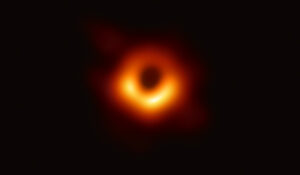
The First Image of a Black Hole
This is the first-ever image of a black hole, released on April 10, 2019. Captured by the Event Horizon Telescope, it shows the supermassive black hole at the centre of the Messier 87 (M87) galaxy, located about 55 million light-years from Earth.
Credit: Event Horizon Telescope Collaboration / science.nasa.gov/resource/first-image-of-a-black-hole/
The Arabic word in this verse — رَتْقًا— means “a closed-up mass.” In 1924, Edwin Hubble discovered the reality of the Big Bang and the existence of black holes through his telescope. It was also ascertained that the universe is always expanding, not fixed in size. This ever-expanding universe is now an accepted reality among modern-day scientists.
The phrase “Do not the disbelievers see” may seem insignificant at first glance, but it carries profound meaning. Only about a decade ago, scientists believed black holes were invisible and could not be seen because no light escapes from within them. However, over the last six to seven years, scientists have been able to see and capture images of black holes using the Event Horizon Telescope.
This verse goes on to say that water is the foundation of life, a fact now established by science. Accordingly, when NASA looks for planets that can sustain life, it looks for water — the key ingredient for life. On one hand, we have scientists working in million-dollar laboratories; on the other, an illiterate man dwelling in the deserts of Arabia. We see now how the prescient words of the Holy Qur’an have been fulfilled.
Fingerprint Identification
At a time when identity is authenticated using fingerprints, facial recognition, and biometric scanning, the study of individuality has reached unprecedented accuracy. Among all these identifiers, the fingerprint remains perhaps the most reliable and unique marker of the human being. According to the U.S. Department of Justice, fingerprint identification has no known cases of duplication among billions of records worldwide. What is even more astonishing is that this modern scientific finding was hinted at over fourteen centuries ago in the Holy Qur’an—a revelation made long before fingerprint science had emerged. The following verse, which also refers to the Day of Judgment, makes mention of this:
حَتّىٰ اِذَا مَا جَآءُوْهَا شَهِدَ عَلَيْهِمْ سَمْعُهُمْ وَ اَبْصَارُهُمْ وَ جُلُوْدُهُمْ بِمَا كَانُوْا يَعْمَلُوْنَ
Till, when they reach it, their ears and their eyes and their skins will bear witness against them as to what they had been doing. [41:21]
When this verse was revealed, there existed no scientific understanding of fingerprints, let alone their use in identification. DNA fingerprinting first originated in the lab of geneticist Sir Alec Jeffreys in 1984. Just two years later, in 1986, DNA fingerprinting was used for the first time in a criminal investigation. It has since revolutionized identification in forensic science and legal medicine, becoming one of the most prominent applications of human molecular genetics. However, the fingerprint is more than simply a tool of forensic analysis—it is a divine mark inscribed upon the human body, representing our individuality, origin, and destiny.
The Preservation of Pharaoh’s Body
The preservation of the body of Pharaoh is one of the most eye-opening pieces of evidence for the truthfulness of the Holy Qur’an. The body of Pharaoh, who rejected the prophethood of Moses, was found in the late 19th century.
Many scholars, as well as Hazrat Khalifatul-Masih IV (may Allah have mercy upon him), identify this Pharaoh as Ramses II, while others, such as Hazrat Musleh-e-Mau’ud (may Allah be pleased with him), believe it was his son Merneptah.
In his book Revelation, Rationality, Knowledge and Truth, Hazrat Khalifatul-Masih IV (may Allah have mercy upon him) noted, “All that the Bible mentions of Pharaoh and his pursuing army is that each of them was drowned without exception.” This is apparent in the following Biblical verse:
“Then the waters returned and covered the chariots, the horsemen, and all the army of Pharaoh that came into the sea after them. Not so much as one of them remained. But the children of Israel had walked on dry land in the midst of the sea …” [Exodus 14:28-29]
While the Bible asserts that Pharaoh and his hosts were all drowned in the sea, the Qur’an presents a different account. Allah states:
فَالْيَوْمَ نُنَجِّيْكَ بِبَدَنِكَ لِتَكُوْنَ لِمَنْ خَلْفَكَ اٰيَةً ۚ وَ اِنَّ كَثِيْرًا مِّنَ النَّاسِ عَنْ اٰيٰتِنَا لَغٰفِلُوْنَ
So this day We will save thee in thy body alone that thou mayest be a Sign to those who come after thee. And surely, many of mankind are heedless of Our Signs. [10:93]
When the Qur’an was revealed, the tombs of the Egyptian kings lay buried deep beneath layer upon layer of desert sand. Little was known of the science of mummification by the people of that age, certainly not by the Arabs. Yet, in fulfilment of this prophecy, the mummy of Ramses II was discovered in 1881 in the Royal Cache at Deir el-Bahri, and Merneptah’s mummy was unearthed in 1898 in the tomb of Amenhotep II, likely originally buried in the Valley of the Kings. Both bodies can be observed today in Cairo’s Egyptian Museum. It is especially noteworthy that, contrary to this Qur’anic statement, the Biblical narrative does not so much as hint at the possibility of the retrieval of Pharaoh’s body. Until the Qur’an mentioned the preservation of Pharaoh’s body as a sign for future generations, no historical source had ever referred to this.
Although these are just a few of the countless prophecies and scientific truths fulfilled by the Holy Qur’an, they clearly illustrate its universal veracity. The fact of the matter is that there is no conflict between the Qur’an and science. There is no contradiction in the two. All of the claims in the Qur’an are validated by scientific findings.
In his book The Bible, the Qur’an and Science, Dr. Maurice Bucaille expresses this view: “There is not a single verse in the Qur’an where natural phenomena are described and which contradicts what we know for certain from our discoveries in sciences.” Nonetheless, the Holy Qur’an must be held in higher regard and given precedence due to the fact that it contains the blueprint for all of science.
The Promised Messiah (peace be upon him) proclaims:
“It is my faith that the Qur’an is such a perfect book that no modern philosophy or science—even after advancing a thousand times from its present state—can ever prevail against it.” [Malfuzat – English Translation of Urdu Volume 10, p. 505, 2022 ed.]
While many scientific truths may have been known before the descent of the Qur’an, many are still being discovered in the present age, and other verities are yet to be revealed to the world.
وہ روشنی جو پاتے ہیں ہم اس کتاب میں
ہوگی نہیں کبھی وہ ہزار آفتاب میں
The light that we can find in this Book;
Can never be found in a thousand suns.
[Barahin-e-Ahmadiyya – Part V, p. 11, 2018 ed.]


