


Imagine history as a vast tapestry woven with the threads of war. From the rise and fall of empires to the shaping of societies, battles have been the loom that pulls it all together. Nations, tribes, and kings have wielded war like a tool – chasing power, wealth, or territory. Great civilizations were born on battlefields, and their ruins still whisper tales of conquest. Even today, ancient artifacts and art bear the scars and glory of those clashes.
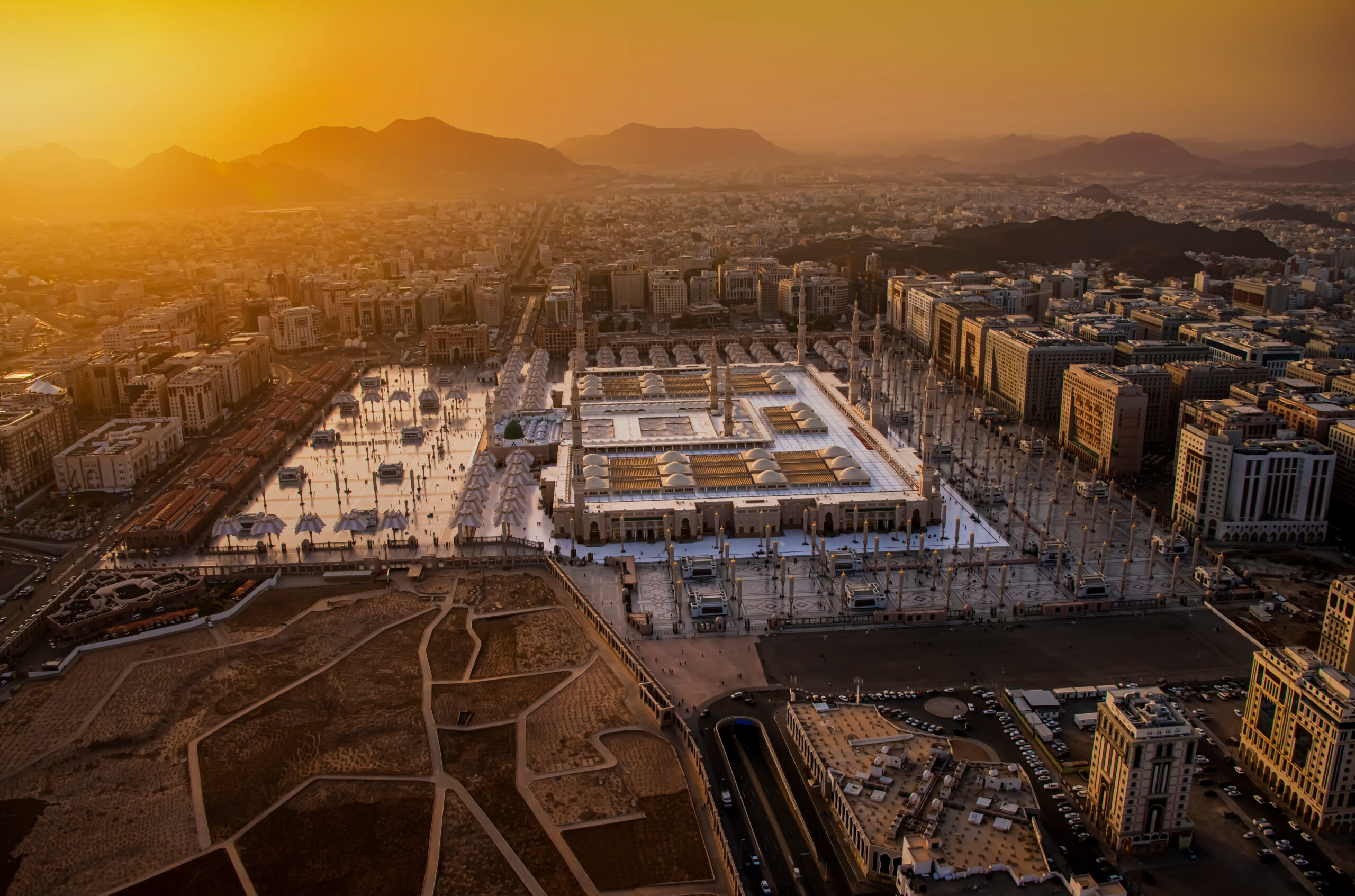
Now picture a man who arrived in a small town called Yathrib, later known as Madinah, after fleeing persecution in Makkah. Within just ten years, that modest city-state became the heart of a new civilization, spreading the message of Islam across Arabia. Yet with expansion came conflict.
The Holy Qur’an tells us these wars were forced upon the early Muslims (22:40), and that Prophet Muhammad (peace and blessings of Allah be upon him) and his followers abhorred violence (2:217). Still, they were compelled to fight for survival.
During his years in Medina, the Prophet (peace and blessings of Allah be upon him) led or oversaw around 88 military expeditions. Some were small patrols, whilst 27 were major campaigns under his command. These revealed not only his moral integrity but also his unmatched genius as a strategist. Among them, the Conquest of Makkah stands as his most remarkable triumph.
This essay highlights one brilliant tactic from that campaign, compared to a legendary Chinese strategy from 342 BCE. Together they show that ranking the Prophet (peace and blessings of Allah be upon him) among the world’s greatest military minds is not devotion—it is historical fact.
How War Evolved
Modern historians estimate the earliest recorded war to be around 2700 BCE, between Sumer (modern western Iraq) and Elam (southwestern Iran) in Mesopotamia. Prehistory remains a mystery, but earlier clashes surely occurred.
As technology advanced, warfare changed too. Stone and wood weapons were replaced by iron swords, spears, and bows. Foot soldiers were complemented by mounted warriors on donkeys, horses, and camels. Animals were trained for combat—like Raja Porus’ war elephants in India or the Mongols’ lightning cavalry, the engine of their vast empire.
By the 9th century CE, China introduced gunpowder. Muskets, cannons, and explosives allowed armies to strike from afar. Victory shifted from sheer numbers to firepower and logistics. Naval battles became cannon duels on armoured ships. Airplanes later turned the skies into killing fields.
In the modern West, mastery of gunpowder and its descendants granted dominance – culminating in nuclear weapons capable of erasing cities. Hiroshima and Nagasaki in 1945 served as a sobering glimpse of war’s apocalyptic potential.
The Birth of Strategy
Weapons alone never won wars—brains did. Early fighters charged in chaotic mobs until experience taught discipline. Formations like the Greek phalanx transformed scattered warriors into solid walls.
Logistics became crucial. How long could an army sustain itself? Planning supplies became as important as swords.
Espionage revolutionized warfare. Knowing the enemy’s strength, plans, and weaknesses could determine victory. Spies became unsung heroes.
Temporary militias gave way to professional standing armies. Soldiers drilled relentlessly, mastering strategy as a career. Empires that built robust military institutions gained unbreakable edges in defence and expansion.
In this new era, the true difference was leadership – commanders who could think ahead and act with genius. Two great civilizations, Greece and China, became the earliest schools of war.
Genius in the East and West
From the age of seven, boys in Ancient Greece were trained in weapons, tactics, and unit cohesion. Sparta’s Agoge was the pinnacle—a brutal forge producing warriors like King Leonidas. In 480 BCE, his 300 Spartans held Xerxes’ 300,000 Persians at Thermopylae for three days, buying Greece time to unite and repel the invasion, though at a steep cost.
Alexander the Great, who conquered half the known world by age 32, was a product of such systems. He died young of a mysterious illness, leaving historians to wonder what might have been if he had lived longer.
In the East, China’s military tradition was uniquely written. From the dawn of civilization, treatises on war philosophy poured forth. Jiang Ziya’s Six Secret Teachings (11th century BCE) helped found the Zhou Dynasty, which lasted nearly 800 years.
Sun Tzu’s The Art of War, written around 500 BCE, became immortal. Influencing East Asia for centuries. It reached Europe in the 17th century, was translated into English in 1905, and influenced generals like Douglas MacArthur and Norman Schwarzkopf.
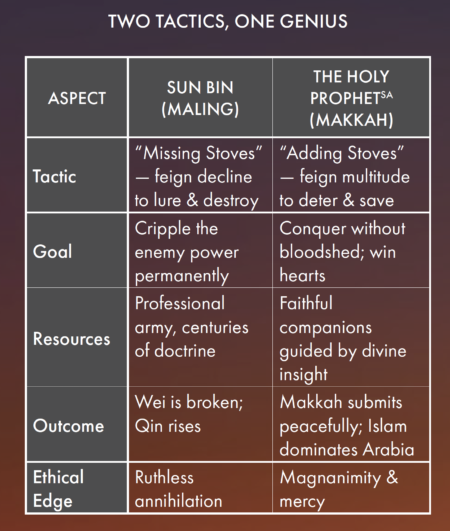
Then came Sun Bin, Sun Tzu’s intellectual heir. Less famous, but in 342 BCE, at the Battle of Maling, he executed a tactic so brilliant it cemented his name among China’s elite strategists.
We will compare Sun Bin’s masterpiece with the Holy Prophet Muhammad’s strategy at Makkah. Sun Bin commanded a trained army with centuries of doctrine; the Prophet (peace and blessings of Allah be upon him) had no academy, no professional army, and no ancient manuals, yet his tactics were breathtakingly effective.
Scene One: The Battle of Maling, 342 BCE
The mighty Zhou Dynasty had crumbled into the Warring States era—seven kingdoms locked in endless strife. In the Wei state, a prodigy named Sun Bin rose. Trained under the reclusive master Guiguzi and steeped in The Art of War, he became Wei’s military advisor.
Betrayal struck when his classmate, General Pang Juan, framed him for treason. The king ordered Sun Bin’s kneecaps to be shattered. Though crippled, Sun Bin survived and fled to the state of Qi, where his brilliance earned him the role of chief strategist.
In 342 BCE, Wei invaded its ally Han. Han requested Qi’s help. Sun Bin devised a daring ploy: instead of reinforcing Han, Qi would strike Wei’s capital, Daliang. A 120,000-man army marched forth, nominally led by General Tian Ji, but actually commanded by Sun Bin.
Wei recalled its forces from Han. Near Daliang, 100,000 Wei soldiers faced Qi. Prince Shen was a figurehead; Pang Juan held real command—the same man who had maimed Sun Bin.
Sun Bin’s goal wasn’t conquest but crippling Wei’s military might with minimal Qi losses. He needed Wei to be weak but Qi to be strong.
When armies clashed, Sun Bin ordered an immediate retreat. Pang Juan interpreted this as cowardice and pursued.
At night, Sun Bin issued a curious order: to reduce the number of cooking stoves. In an era without drones, scouts estimated army size by counting campfires, with one fire for every 10–12 men.
On the first night, the number of stoves suggested 100,000 men (slightly fewer). Wei spies reported 20,000 deserters while Qi was down to 100,000.
The stoves halved on the second night, indicating 50,000 men. Pang Juan smelled victory.
By the third night, there were stoves for just 20,000 men. Convinced Qi was crumbling, Pang Juan advanced with his elite cavalry.
Sun Bin had chosen Maling, a narrow valley flanked by hills, and hid 10,000 archers in the trees. On a central tree, in huge letters, he carved the words: “Pang Juan dies beneath this tree.”
As dusk fell, Pang Juan entered the gorge. Spotting the inscription on the tree, he lit a torch to read it. That flare served as the signal.
Arrows rained down like a storm. Cavalry struggled to maneuver. Pang Juan died instantly; most riders perished with him. Qi’s infantry cleared out the survivors. Prince Shen was taken prisoner. Wei’s remaining army panicked and disintegrated. Wei never recovered, soon losing large portions of territory to Qin.
Historians dubbed this the Tactic of Missing Stoves. It resonated through Chinese military academies for centuries, elevating Sun Bin to legendary status.
Scene Two: The Conquest of Makkah, 630 CE
Nearly a thousand years later, in 630 CE, another master tactician prepared for war – but his aim was peace.
Two years earlier, the “Treaty of Hudaybiya” had secured a truce between the Muslims of Madinah and the Quraysh of Makkah. Tribes could form alliances with either side, but allies were protected from attack.
In early 630 CE, the Quraysh-backed Banu Bakr raided Muslim-allied Banu Khuza’ah, killing several people. In blatant violation of the treaty, the Quraysh aided the assault. Khuza’ah pleaded for retribution in Madinah.
The Prophet (peace and blessings of Allah be upon him) had every right to respond, yet he moved with restraint.
He offered the Quraysh three options:
- Pay blood money for the slain
- Disavow the Banu Bakr
- Declare the treaty invalid
The Quraysh arrogantly chose the third option, which meant war.
The Prophet (peace and blessings of Allah be upon him) mobilized 10,000 men but kept the target secret from most of his companions to prevent leaks. After a week’s march, the army camped at Marr al-Zahran, a valley only a few miles from Makkah. Only then did the destination become known.
His aim wasn’t just conquest but a bloodless victory. As ruler and commander, he loathed unnecessary slaughter. The Treaty of Hudaybiya proved peace was his preference. His true battlefield? Hearts. He won enemies with magnanimity, not just might, as evidenced by his treatment of prisoners and former foes.
Strategically, maintaining secrecy was crucial. If the Quraysh learned of the Muslims’ plan too early, they would call upon allies from Ta’if and Hawazin. A bloody siege would weaken Muslim forces and jeopardize their goal of capturing Makkah. As the guardian of the Kaaba, Makkah was Arabia’s spiritual and political heart. Losing it would unravel everything.
Night fell at Marr al-Zahran. Normally, 10–12 soldiers shared one fire. The Prophet (peace and blessings of Allah be upon him) issued a striking order: Let every man light his own fire. Ten thousand fires blazed. From afar, the valley glowed like a sea of stars – suggesting 100,000 warriors.
This maneuver mirrored Sun Bin’s tactic, but inverted it. Where Sun Bin feigned weakness to lure and destroy, the Prophet (peace and blessings of Allah be upon him) projected overwhelming strength to deter and save lives.
The Quraysh suspected retaliation but were blind to the march. Their chief, Abu Sufyan, scouted with two companions. Cresting a ridge, they froze: an ocean of flames. “Whose army is this? By God, I’ve never seen such fires!” Abu Sufyan gasped.
“Must be Khuza’ah,” a companion guessed.
“Khuza’ah? A pitiful tribe couldn’t light this inferno!”
A Muslim patrol captured them and brought them before the Prophet (peace and blessings of Allah be upon him). At dawn, after Fajr prayer, Abu Sufyan stood trembling.
“Has the time not come for you to affirm there is no god but Allah, and I am His Messenger?” The Prophet asked.
“My parents be sacrificed for you,” Abu Sufyan replied. “You are so forbearing, generous, and kind. I now know—if there were any god besides Allah, he would have helped us.”
Desperate for mercy, he asked: “If Makkah lays down arms, will they be safe?” The Prophet (peace and blessings of Allah be upon him) declared a general amnesty:
“Whoever stays home is safe. Whoever enters the Sacred Mosque is safe. Whoever discards weapons is safe. Whoever seeks refuge under Bilal’s banner is safe. Whoever enters the houses of Abu Sufyan or Hakim ibn Hizam is safe.”
Abu Sufyan’s resolve was shattered. To seal the psychological blow, the Prophet (peace and blessings of Allah be upon him) had him watch the Muslim columns march past. Regiment after regiment – immaculate, endless. When the Prophetsa himself passed, Abu Sufyan raced back, proclaiming through Makkah’s streets:
“O Quraysh! Muhammad comes with an army you cannot withstand! Stay home, enter the Mosque, or come to my house – you’ll be safe!”
Panic spread. Homes were barred shut.
Muslim forces entered from all sides. A few hotheads resisted briefly and a few dozen fell. By noon, Makkah was under Muslim rule. At the Kaaba, the Prophet (peace and blessings of Allah be upon him) proclaimed universal pardon. No revenge. No slaughter.
A city conquered without war. Muslim strength remained intact for future campaigns such as Ta’if and Hunayn. A complete triumph – strategic, moral and spiritual.
Sun Bin’s brilliance shattered an empire. The Prophet Muhammad’s brilliance united one, without bloodshed.
One used deception to destroy; the other used perception to preserve. Both were masters of human psychology, but only one turned victory into peace.

The Final Verdict
No academy trained him. No manuals guided him. No standing army drilled under him. Yet in the crucible of history, the Prophet Muhammad (peace and blessings of Allah be upon him) stands among the greatest commanders ever known.
His was the “Tactic of Adding Stoves” – a triumph not of force, but of faith and compassion.
History remembers conquerors.
Faith remembers redeemers.
The Holy Prophet Muhammad (peace and blessings of Allah be upon him) was both, but chose mercy over might.
References
1. Son Pin Heihō: Mō Hitotsu no “Sonshi” [Japanese], Kanaya Osamu, 2008
2. Sahih al-Bukhari, Hadith 4280
3. Siratun Nabi [Urdu Translation], Abd al-Malik ibn Hisham, 1994, vol. 2, pp. 262-287 (published by Idara Islamiyat, Lahore)
4. Siratun Nabi [Urdu], Shibli Nomani, 2012, vol. 1, pp. 342-353 (published by Maktaba Islamia, Lahore)
5. Ar-Raheeq al-Makhtum [Urdu], Safiur Rahman Mubarakpuri, 2002, pp. 535-557 (published by Al-Maktaba Assalafiyya, Lahore)


