

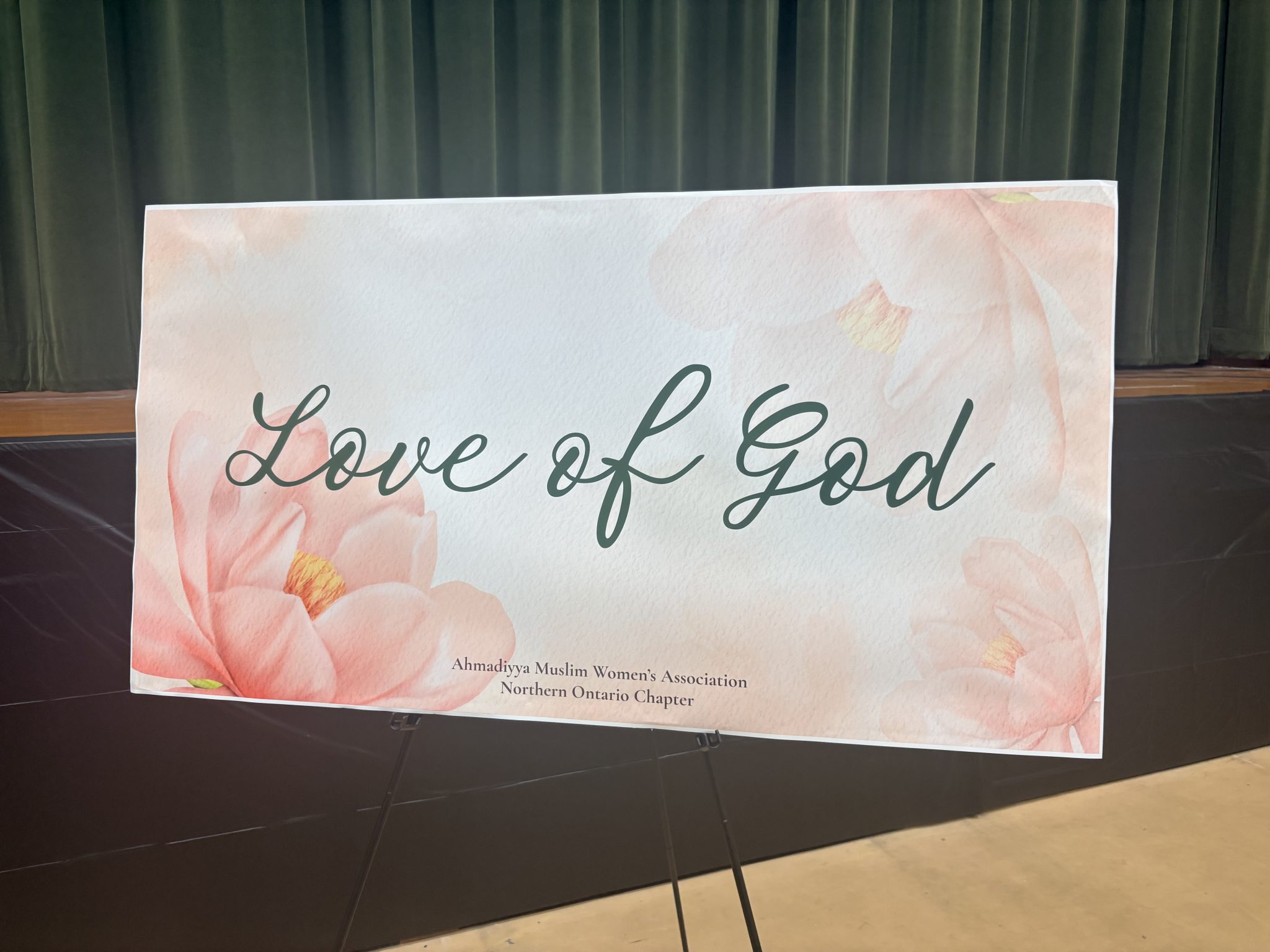
The Ahmadiyya Muslim Jama’at hosted the Annual Northern Ontario Regional Interfaith Symposium on Saturday, 24 October 2026, at the Jamia Ahmadiyya Canada campus in Innisfil, Ontario. About 110 guests attended. The theme was “Love of God”, and speakers representing Islam, Hinduism and Christianity each presented what their faith teaches about it.
The speakers addressed how love for God is cultivated through prayer, devotion, compassion and service to humanity. A question-and-answer session followed, in which guests asked about the place of faith in the challenges of modern life.
Sadaf Shah Sahiba facilitated the panel. Her questions asked the speakers about the place of love for God in everyday life, and how faith can help people through personal difficulty and strengthen their relationships with God and with one another.
Love of God Through the Lens of Islam
Madiha Ahmad presented the Islamic perspective, speaking of the closeness of God to humanity and of His mercy and compassion. Drawing on the Holy Qur’an, including Surah Al-Fatihah, she explained the significance of a sincere and personal relationship with God.
She recounted a well-known story of Rabia al-Adawiyya (also known as Rabia of Basra), who was once seen carrying a torch and a pitcher of water. Asked why, she explained that she wished to throw fire into Paradise and pour water into Hell, so that neither would stand as a veil between people and God, and it would be plain who worships Him out of love alone, not out of fear of Hell or longing for Paradise.[1]
Love for God, she said, must move beyond words and feelings into everyday conduct. If God is Merciful, people should show mercy; if He is Forgiving, they should learn to forgive; and if He is Just, they should strive to act justly. She presented the Holy Prophet Muhammad (sa) as the perfect model of these qualities.
She stressed service to others regardless of their religious beliefs, saying that love of God must show itself in compassion and in practical help for neighbours and for those in need.
On the distractions of modern life, she spoke of making deliberate time for God. The five daily prayers in Islam give regular moments to pause and turn towards Him. She also cited the Qur’anic assurance that hearts find comfort in the remembrance of Allah [13:29].
Love, Devotion and Service in Hinduism
Nanda Mohini Devi Dasi presented the Hindu perspective, drawing on Hindu scripture and on teachings associated with Lord Krishna. She acknowledged the diversity of Hindu belief and the many spiritual paths by which people seek a connection with the Divine.
Referring to the Bhagavad Gita, she spoke of seeing Krishna in everything and everything in Krishna,[2] and of the spiritual bond between God and every living being. She linked this to compassion towards animals, to avoiding harm, and to making thoughtful choices in daily life.
Love, she said, is not only about receiving; it must be expressed in action. Through devotion, selfless service and a conscious effort to remember God, a person can build a deeper relationship with Him.
Asked how to manage the mind during emotional difficulty, she referred to the teaching of the Bhagavad Gita that the mind can be either a friend or an enemy.[3] Spiritual growth, she explained, involves learning to guide the mind while keeping a personal connection with God. That connection is not confined to formal worship. It can be nurtured while appreciating nature or carrying out ordinary responsibilities.
She encouraged guests to put their own skills and talents to use in serving others, so that devotion becomes a practical expression of love for God and for humanity.
Love of God in Christianity
Catherine Manson presented the Christian perspective, drawing on the teachings of the Bible on compassion, faith and keeping God at the centre of life.
She spoke of scripture as a source of guidance across generations. In a world marked by conflict within countries, communities, families and individual lives, she encouraged people to return to their faith for direction.
On keeping a connection with God amid modern distractions, she spoke of making time for prayer, meditation and other spiritual practices, pointing to the example of Jesus (as), who withdrew to quiet places to pray.[4]
She shared a personal account of praying for her child during a difficult moment, and described how scripture and prayer helped her reconnect with her faith and find clarity in a time of uncertainty. She also spoke of the need to nurture faith in younger generations.
Faith, Suffering and Mental Health
Questions from guests turned to suffering and mental health. One guest asked how the love of God can be understood in a world where so many people suffer. Another asked how people can face mental health challenges while maintaining their spiritual well-being.
The Islamic response to the question of hardship drew on the promise of the Holy Qur’an, “Surely, there is ease after hardship. Aye, surely, there is ease after hardship” [94:6-7]. The verse encourages perseverance and the recognition that difficult experiences can become a means of personal and spiritual growth.
On mental health, the panel stressed remembering God throughout life and keeping Him at the centre of thought, decision and action, so that a person can draw spiritual strength in the face of difficulty. The speakers also spoke of instilling love for God in children, so that the next generation grows up with a lasting spiritual foundation.
The speakers returned, too, to the challenge of keeping faith amid constant notifications, messages and competing demands, and pointed to prayer, reflection, scripture and devotion as ways to stay connected to God.
A Shared Call to Compassion and Service
Although the speakers drew on different scriptures, each returned to the idea that love for God should be visible in the way people live. Whether through mercy and justice, devotion and selfless service, or prayer and reflection, that love calls people beyond themselves and towards compassion for others, including in times of uncertainty and hardship.
The symposium closed on a question shared across religious traditions. How can love for God become visible in our everyday choices and in the way we treat others?
References
- Annemarie Schimmel, foreword to Margaret Smith, Rabi’a the Mystic and Her Fellow-Saints in Islam (Cambridge University Press, 1984 reprint), p. xxvii.
- Bhagavad Gita 6.29 to 6.30
- Bhagavad Gita 6.5 to 6.6.
- The Bible (NIV), Luke 5.16; see also Mark 1.35.