

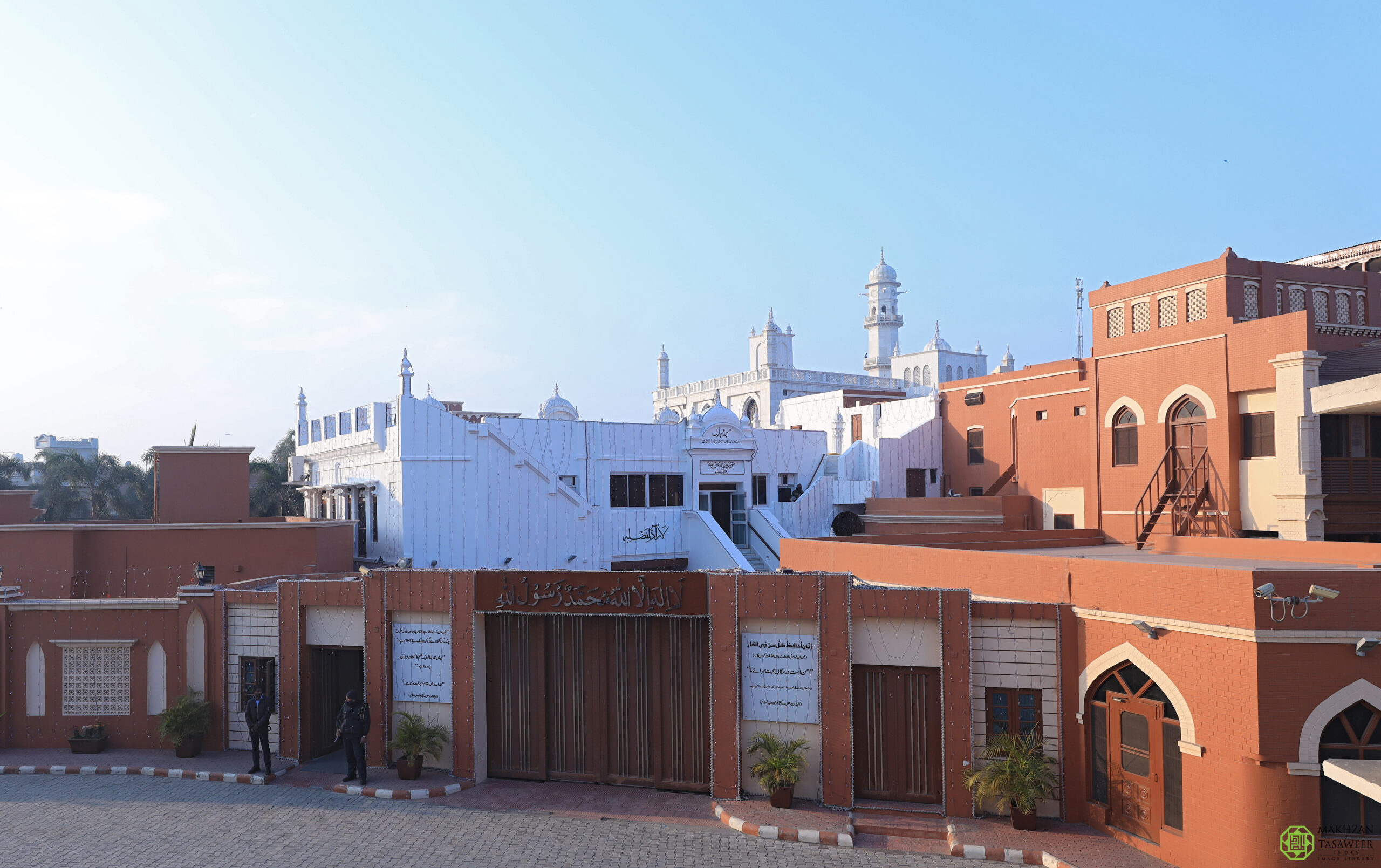
It was decreed that the blessings and insights of the Holy Qur’an would be revived through Hazrat Mirza Ghulam Ahmad, the Promised Messiah, peace be upon him. For this reason, his hometown of Qadian—destined to become a centre of Divine Unity—was granted a special relationship with the Holy Qur’an. By Divine decree, an extraordinary love for the Qur’an was placed in the hearts of the Promised Messiah’s forefathers.
The Promised Messiah’s ancestor, Mirza Hadi Baig, entered the Indian subcontinent during the Mughal era in 1530 CE, migrating with a caravan of 280 people from Samarqand in Central Asia. He settled a forested wilderness and named it Islam Pur. This later became Islam Pur Qazi Majhi and, over time, “Qadian.”
The independent state of Qadian endured for nearly one hundred and seventy-five years, during which there was an exceptional atmosphere of Qur’anic devotion.
At certain times, as many as a hundred memorizers of the Qur’an lived there, along with scholars and the righteous, always present. However, when the Sikhs occupied this unparalleled region, its grand mosques were either demolished or converted into dharamshalas (Hindu prayer halls). The central Islamic library of Qadian, which housed 500 handwritten manuscripts of the Holy Qur’an, was burned in a most disrespectful manner, and many traces of Islamic heritage were effaced. [see Kitab al-Bariyyah, Ruhani Khaza’in, vol. 13, pp. 162, 175]
Yet it was from this very smouldering spark that the blazing flame of the Qur’an was destined to arise—through that servant of God whose heart overflowed with love for Allah and His Messenger (may peace and blessings of Allah be upon him). It was in the shade of this love that he developed such an overwhelming passion for the Holy Qur’an, unmatched in the past centuries.
Expressing his deep love for the Holy Qur’an, he said:
دل میں یہی ہے ہر دم تیرا صحیفہ چوموں
قرآں کے گرد گھوموں کعبہ مرا یہی ہے
My heart yearns every moment to kiss Thy Book;
And to perform circuits around the Qur’an, for this is my Kaaba.
[Ahmadis and the Aryas of Qadian, p. 65, 2023 ed.]
In this article, I focus on one aspect of the Promised Messiah’s love for the Holy Qur’an—specifically, a few testimonies about his recitation and profound reflection on it.
In this article, I focus on one aspect of the Promised Messiah’s love for the Holy Qur’an—specifically, a few testimonies about his recitation and profound reflection on it.
Brought Up in Love for the Qur’an
The Promised Messiah’s very nature was fashioned from the love of the Qur’an. From childhood, he would recite the Holy Qur’an day and night, ponder over it, and write notes in its margins.
Hazrat Mirza Isma’il Baig (may Allah be pleased with him), who served the Promised Messiah (peace be upon him) since the 1870s, related:
“Sometimes the Promised Messiah’s father, Hazrat Mirza Ghulam Murtaza, would call me and ask, ‘Tell me, what does your Mirza do?’ I would say, ‘He studies the Qur’an.’ He would reply, ‘Does he ever breathe?’ Then he would ask, ‘Does he sleep at night?’ I would answer, ‘Yes, he sleeps, and then he wakes up and offers prayers.’ Upon this, Mirza Sahib would say, ‘He has abandoned all other ties. I employ others in work. His brother is very capable, but he is engaged elsewhere.’” [Tarikh-e-Ahmadiyyat, vol. 1, p. 65]
His Morning Recitation
Hazrat Mirza Din Muhammad of Langerwal (may Allah be pleased with him) related:
“I have observed the Promised Messiah (peace be upon him) since my childhood. I first saw him during the lifetime of Mirza Ghulam Murtaza Sahib when I was just a child. It was his habit that he would go to sleep soon after the Isha prayer and then get up at around one o’clock for tahajjud. After offering tahajjud, he would continue reciting the Holy Qur’an. When the morning adhan was called, he would offer the Sunnah prayers at home and then go to the mosque for the Fajr prayer.” [Seeratul Mahdi, narration 491]
One of his childhood companions, Lala Malawa Mal, who was a Hindu, bore this testimony:
“He had a special love for the Qur’an as well. He would always wake up at about two or three in the night and begin prayer. After offering his prayers with great tranquillity, he would then recite the Holy Qur’an. After that he would offer the Fajr prayer, then sleep for a short while. He used to call that short sleep his ‘luminous nap’. After that, he would go out for a walk, and even during the walk, he would remain engaged in religious discussions.” [Al-Fazl, December 24, 1935, p. 5]
Hazrat Hakim Muhammad Zahid (may Allah be pleased with him), a companion from Shorkot, narrated:
“Except for the last three or four years of his life, it was generally his practice that, after offering the Fajr prayer in Masjid Mubarak in Qadian, as soon as he returned home, he would begin reciting the Qur’an. He recited somewhat quickly, but every word was pronounced with perfect clarity. He would usually recite while pacing back and forth. Generally, he recited one siparah (part) a day, and sometimes he would recite a full manzil (one-seventh of the Qur’an).
“My own practice was that as soon as he would pick up the Qur’an for recitation, I too would take a copy of the Qur’an and begin reciting along with him. In this way, I was able to correct the mistakes in my own recitation. After the recitation, he would go out for a walk.” [Monthly Ansarullah, October 1974, p. 30]
His Recitation in Prayer
Hazrat Mirza Bashir-ud-Deen Mahmood Ahmad, Khalifatul-Masih II (may Allah be pleased with him), related:
“When, due to illness, the Promised Messiah (peace be upon him) could not go to the mosque, he would often lead the Maghrib and Isha prayers in congregation at home. In the Isha prayer, he would almost without fail recite these verses of Surah Yusuf [12:84–93]— from بَلْ سَوَّلَتْ لَكُمْ up to اَرْحَمُ الرّٰحِمِيْنَ. He would recite them in such a deeply moving tone that one’s heart would be overwhelmed. That voice still resounds in my ears today.” [Tafsir-e-Kabir, vol. 4, p. 505, 2023 ed., commentary of 12:93]
Hazrat Dr. Mir Muhammad Isma’il (may Allah be pleased with him) stated:
“In 1895, I had the good fortune to spend the entire month of Ramadan in Qadian, and I offered the Tahajjud prayer behind the Promised Messiah (peace be upon him) throughout the month. His practice was that he would offer the Witr at the beginning of the night, and then perform the eight rak’ahs of Tahajjud in sets of two, near the end of the night. In these prayers he would always recite Ayatul-Kursi (2:256) in the first rak’ah … and Surah Ikhlas (112) in the second. In ruku and sajdah he would frequently recite يَا حَيُّ يَا قَيُّومُ بِرَحمَتِكَ أَسْتَغِيثُ (‘O Ever-Living, O Self-Subsisting, it is Your mercy that I seek for help’), and he would recite it in such an audible voice that I could hear it clearly. He would always partake of the pre-dawn meal (suhoor) after the Tahajjud prayer.” [Seeratul Mahdi, narration 320]
Recitation in a State of Passionate Love
Hazrat Maulvi Rahim Bakhsh (may Allah be pleased with him) stated:
“Once, I came to Qadian. The Promised Messiah (peace be upon him) was staying in a room, and I slept outside that room. In the night, I woke up and heard the Promised Messiah reciting the Holy Qur’an in a loud and passionate voice—as if a lover were expressing his love to his beloved. The condition of his love is beyond my ability to describe.” [Al-Hakam, July 21, 1934, p. 4]
Deep Reflection Upon the Qur’an
Hazrat Mirza Bashir Ahmad (may Allah be pleased with him) narrates:
“A certain gentleman told me that once the Promised Messiah (peace be upon him) was travelling from Qadian to Batala in a palanquin (a journey of about five hours). As soon as he left Qadian, he opened a pocket-sized copy of the Qur’an and began reciting Surah al-Fatihah. For the entire five-hour journey, he remained absorbed in reciting this same Surah with such deep absorption as if it were a vast ocean, and he was diving into its depths in search of pearls of the love and mercy of his Eternal Beloved.” [Seerat-e-Tayyibah, pp. 11–12, also see Seeratul Mahdi, narration 438]
Mentioning the life of the Promised Messiah (peace be upon him) before his claim, Hazrat Sheikh Ya’qub Ali Irfani (may Allah be pleased with him) said:
“At that time, his occupations were nothing other than worship, remembrance of Allah, and recitation of the Holy Qur’an. It was his habit to recite while walking about. Other people, who were unaware of the inner realities, would often ridicule this practice of his. He had great love for reciting the Holy Qur’an and reflecting upon it.
“His intense passion and enthusiasm for the recitation of the Holy Qur’an shows how deeply he loved and was attached to this majestic Book of Allah, and how pleasing and delightful the Divine Word was to him. This recitation and profound study created in him a burning desire to manifest the truth and greatness of the Holy Qur’an, and Allah made him into a boundless ocean of Qur’anic knowledge. The type of knowledge of theology that was conferred upon him finds no parallel in previous generations.
“In short, he possessed an extreme love for the Holy Qur’an, and a powerful electric current, as it were, ran within him for manifesting its greatness and truthfulness.” [Hayat-e-Ahmad, pp. 172–173, 2013 ed.]
Supplication for Understanding the Qur’an
During his employment in Sialkot, it was often his practice to wrap himself in a chador when going out, leaving only enough of his face visible to see the road. When he returned from court to his residence, he would close the door and occupy himself with recitation of the Holy Qur’an and remembrance of Allah. Because of this habit, some inquisitive individuals became curious and sought to discover what he did behind closed doors. Thus, one day, an inquisitive party uncovered his “secret.”
They “saw with their own eyes” that he was seated on a prayer mat, with the Holy Qur’an in his hands, and in a state of great humility, tenderness, earnest pleading, and heartfelt anguish, he was raising his hands in supplication, saying:
“O Allah! This is Your Word. If You Yourself do not make me understand it, how can I possibly understand it?” [Tarikh-e-Ahmadiyyat, vol. 1, p. 85]
Listening to the Qur’an
Hazrat Mufti Muhammad Sadiq (may Allah be pleased with him) relates from personal observation:
“I have only seen the Promised Messiah (peace be upon him) weep once, and that was in this manner: One day he was going for a walk with his attendants. During those days, Haji Habibur-Rahman of Hajipur’s son-in-law was in Qadian. Someone submitted to the Promised Messiah that this person recites the Holy Qur’an very beautifully. The Promised Messiah (peace be upon him) immediately sat down by the roadside. That gentleman then recited the Holy Qur’an aloud before him. At that time, I observed that the eyes of the Promised Messiah filled with tears.” [Seeratul Mahdi, narration 436]
Respected Sheikh Abdur-Rahman further elaborates on this incident:
“The Promised Messiah (peace be upon him) was greatly pleased with his recitation and instructed him right there, saying that he should recite the Holy Qur’an to him every day after the ‘Isha prayer. For approximately a month, he continued to recite the Qur’an to the Promised Messiah in this manner.” [Ashab-e-Ahmad, vol. 10, pp. 206–207, footnote]
When Hazrat Hafiz Mu’in-ud-Deen (may Allah be pleased with him) was granted the honour of being in the presence of the Promised Messiah (peace be upon him), he was about fourteen or fifteen years old and in extremely weak physical health. When the Promised Messiah (peace be upon him) saw him in that condition, he took him along with himself, gave him food, and then said:
“Hafiz! You should stay with me.”
For Hafiz Sahib, this was an unexpected invitation. As the family of the Promised Messiah (peace be upon him) was highly distinguished and awe-inspiring, people hardly dared to speak in their presence. Hafiz Sahib was astonished at this kindness and compassion, but he readily agreed, with great gratitude, to stay in his service. Hafiz Sahib thought that perhaps he would be expected to do some work, so he said:
“Mirza Ji!” [at that time this was the customary form of address,]“I will not be able to do any work because I am infirm.”
The Promised Messiah (peace be upon him) replied:
“Hafiz! What work do you have to do? We will simply offer prayers together, and you should continue to memorize the Holy Qur’an.” [Ashab-e-Ahmad, vol. 13, p. 287]
Love for the Holy Qur’an
In A’ina-e-Kamalat-e-Islam (The Mirror of the Excellences of Islam), the Promised Messiah (peace be upon him) described his deep love for the Holy Qur’an in the following words:
“Its light has penetrated my heart and I could not have acquired it by any other means. Allah is my Witness that if there had been no Qur’an, I would not have found any delight in life. I find that its beauty exceeds that of a hundred thousand Josephs. I vigorously gravitate towards it, and drink it into my heart. It has nurtured me as an embryo is nurtured and it has a wonderful effect on my heart. My being is lost in its beauty. … I call Allah to witness that I find its countenance more beautiful than everything. Its countenance is made of beauty and it is donned with the robe of excellence.” [The Mirror of the Excellences of Islam, pp. 521–522, 2025 ed.]