

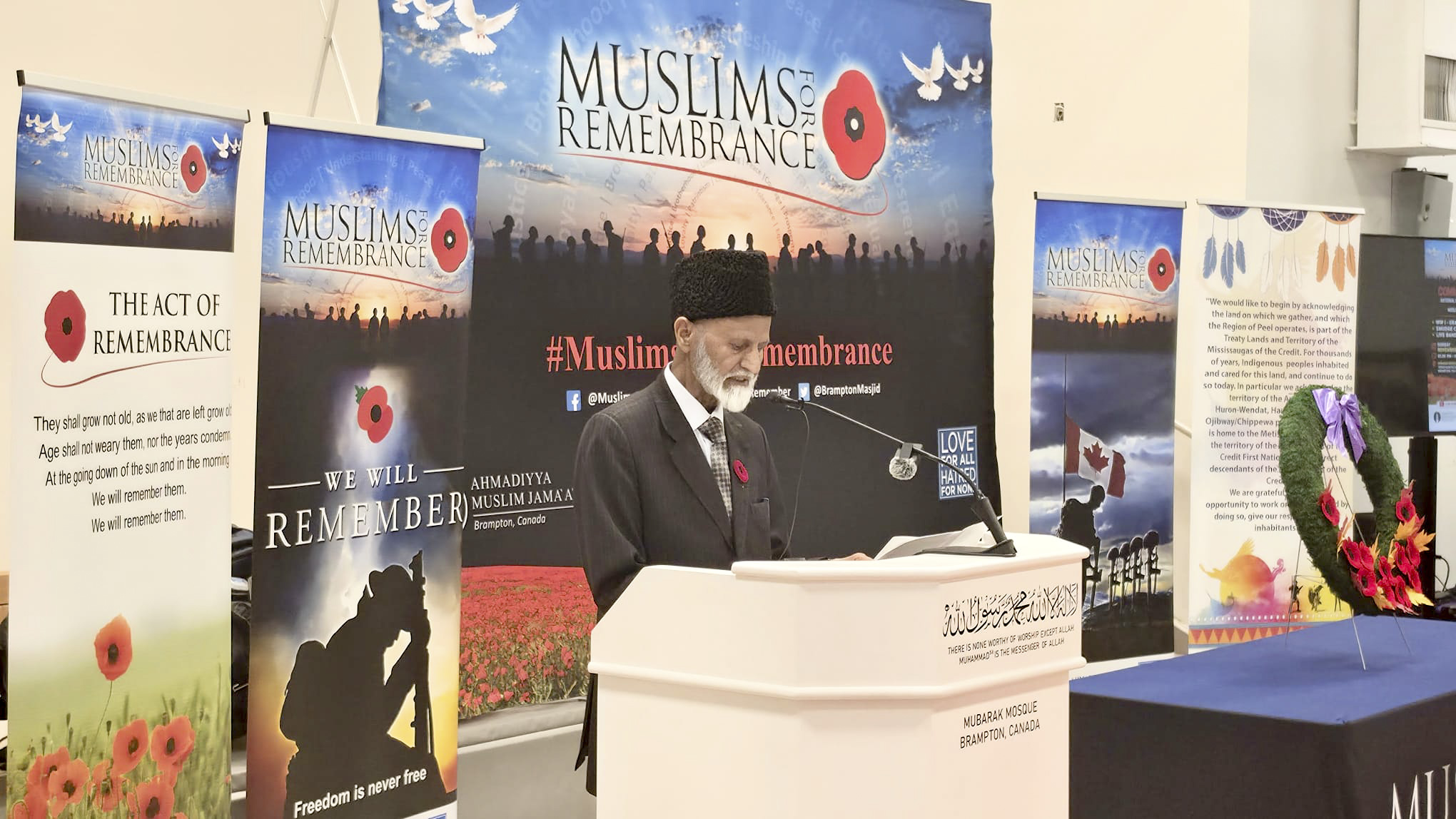
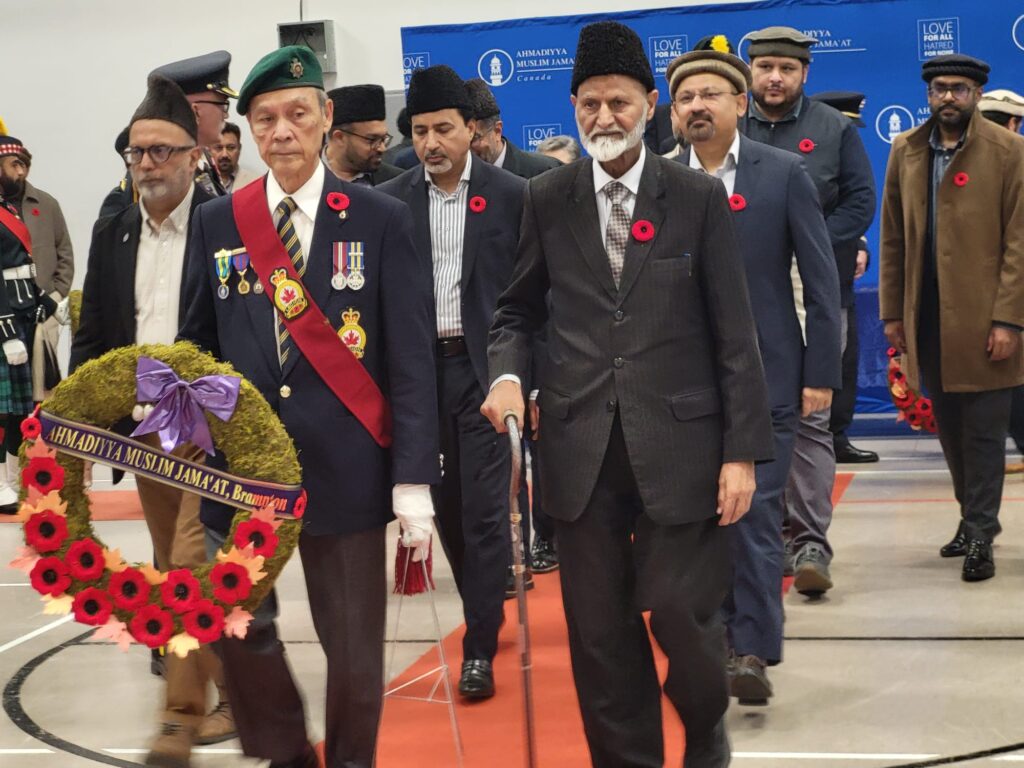
Below is the address of Respected Amir Sahib at the National Indigenous Veterans Day & Muslims for Remembrance event held at Mubarak Mosque in Brampton on Sunday, November 8, 2026.
“Honoured veterans and families, distinguished guests, elected representatives, friends, brothers and sisters: Assalamu alaikum wa rahmatullah. Peace and the mercy of God be upon you all, and welcome to the Mubarak Mosque.
Today we mark two days of remembrance: National Indigenous Veterans Day, which is today, and Remembrance Day, which is this Wednesday.
Let me begin with a story from the life of the Holy Prophet of Islam, peace be upon him. Abdur Rahman ibn Awf was one of his close companions. He came to Madinah with nothing, and over the years, God blessed him with great wealth. One day, a meal was set before him. He looked at the food, and he began to weep.
He was remembering his friend, Mus’ab ibn Umair (ra). Years earlier, they had fought side by side at the Battle of Uhud, when the army of Makkah marched on Madinah to destroy the young Muslim community, Mus’ab carried the Muslim flag, and he fell holding it.
Abdur Rahman said: “Mus’ab was killed, and he was better than me. He had nothing to be buried in but a single sheet. When we covered his head, his feet were bare.” And then he said, with tears in his eyes, that the world had since been opened to us, with all its ease and abundance. (Sahih al-Bukhari, 1274) He could not eat that meal. He knew whose sacrifice had set his table.
I came to this country almost forty years ago. I never wore Canada’s uniform. I never stood in a trench or on a beach in Normandy. And yet every single day of those forty years, I have sat at a table that others sacrificed for; I have a safe home, the freedom to pray in a mosque like this one, children who could grow up with no fear. When I read Abdur Rahman’s words, I think of the men and women whose names are on our cenotaphs. Their sacrifice set my table, and yours.
Islam teaches us that gratitude to those who have done us good is not a courtesy. It is part of our faith. The Holy Qur’an asks a simple question: “Is the reward of goodness anything but goodness?” [Al-Rahman, ch.55:v.61]
That is why today we begin with those whose service Canada took too long to honour.
More than 12,000 First Nations, Inuit and Métis people served Canada in the wars of the last century, and some 500 never came home. Many of them volunteered for a country that did not yet treat them as equals. And when they came home, many were denied the benefits and the land that other veterans received.
One of them was Francis Pegahmagabow, an Ojibwe man from Parry Island and the most decorated Indigenous soldier of the First World War. He came home a hero, and then he spent years fighting a second battle, this time for the rights of his own people.
Indigenous men and women continue to serve in Canada’s Armed Forces today. National Indigenous Veterans Day is Canada finally saying what should have been said long ago: we see you, we honour you, and we are grateful.
As Muslims, we do not stand at a distance from this day. A sacrifice like theirs, demands to be recognised and honoured. So we wear the poppy and we stand in silence, because we remember, and we will never forget.
But remembrance is not only about the past. As we speak, mothers in many lands are burying their sons and daughters. Wherever war is fought, civilians must be protected, the guns must fall silent, and aid must reach those who need it.
Since February, the war with Iran has taken thousands of civilian lives and held a whole region hostage. Only last week, American officials were speaking of further strikes after their elections. In Gaza, a year after a ceasefire, people are still being killed, and families are facing another winter in tents. And in Ukraine, after nearly five years of war, a fragile ceasefire waits on talks.
As our Khalifa (aa) has said, world leaders must not stay silent before injustice.
“As long as they do not courageously strive for a ceasefire, they are invariably responsible.” (Friday Sermon, 28 October 2023)
That includes Israel’s disproportionate aggression against Gaza and unjust assault in Lebanon. For years, His Holiness has warned that the world is sleepwalking towards destruction, and that there can be no lasting peace without absolute justice. The men and women we remember today did not lay down their lives on a battlefield so that today we let this heard-earned peace slip away. We owe it to them, we owe it to their sacrifice to strive hard and harder still to ensure this peace flourishes.
In 1915, a Canadian doctor, John McCrae, wrote from the battlefield:
“To you from failing hands we throw
The torch; be yours to hold it high.“
That torch now passes to our children. So let us tell them about the table they sit at, and who paid for it. Let us raise them to love this country, to be ready to serve it and, if ever needed, to sacrifice for it. And let us raise them to be peacemakers, so that no new names need be carved on our memorials.
Abdur Rahman could not eat that day because he remembered his friend. God does not ask us to leave our tables. He asks us never to sit at them without remembering. So today, we remember them.
May God grant peace to the souls of the fallen, comfort to their families, and justice and peace to our world.” [Ameen!]