

Dr. Tauseef Ahmad Khan
National Secretary Ta’lim, Ahmadiyya Muslim Jama’at Canada
The following is the transcript of a speech was delivered on Saturday, July 11, 2026 in the third session of the 48th Jalsa Salana Canada.
(Please note that this article should be taken as a historical and religious research analysis that provides evidence for the truth of the Holy Qur’an, and not as medical advice. For medical advice, please consult your doctor.)
Every one of you is carrying a phone. Every app on it runs on algorithms. The AI many of you used this week runs on algorithms too. The word “algorithm” comes from the Latinized name of a Muslim mathematician whose step-by-step methods of calculation gave the concept its earliest form: al-Khwarizmi of Baghdad. “Algebra” comes from the title of his book.
From the eighth to the twelfth century, the Muslim world was the beating heart of science. One conviction drove them: all knowledge flows from the One God, all creation has purpose and benefit, and the Qur’an was their inspiration. Today, hardly a Muslim name leads any of these sciences. What happened?
Allah reminds us of where our glory lies. He says in the Holy Qur’an:
لَقَدْ اَنْزَلْنَاۤ اِلَيْكُمْ كِتٰبًا فِيْهِ ذِكْرُكُمْ١ؕ اَفَلَا تَعْقِلُوْنَؒ۰۰
We have now sent down to you a Book wherein lies your glory and eminence; will you not then understand? [21:11]
The Muslims let the Qur’an slip from their hands—and our glory slipped with it.
Then Allah sent the Promised Messiah (peace be upon him). The revival of our glory—through this very Book—is at hand. He said: “Know it for certain then that the door has been opened, and God Almighty has determined to disclose the hidden wonders of the Holy Qur’an to the arrogant philosophers of the world.” [Izala-e-Auham; Ruhani Khaza’in, vol. 3, pp. 466–467]
He also placed a weapon in our hands: “Take the weapon of the Holy Qur’an in your hand; victory will be yours. No darkness can face this Light.” [Malfuzat, vol. 3, p. 10; English rendering in So Said the Promised Messiah, pp. 76–77]
We have seen what this spiritual weapon can do. December 1979, Stockholm. The Nobel Prize in Physics. The first Muslim scientist ever to receive it — our own Professor Abdus Salam. At the Nobel Banquet, he recited the Holy Qur’an to the assembled scientists: “Thou seest not, in the creation of the All-merciful any imperfection. Return thy gaze, seest thou any fissure. Then return thy gaze, again and again. Thy gaze comes back to thee dazzled, aweary.” [67:4–5, as recited by Dr Abdus Salam at the Nobel Banquet, December 10, 1979 (Les Prix Nobel 1979)]
At the summit of science, the greatest Muslim physicist declared that his science was inspired by and began with the Qur’an.
So let us look at the Book—and at the Light it shines upon the sciences.
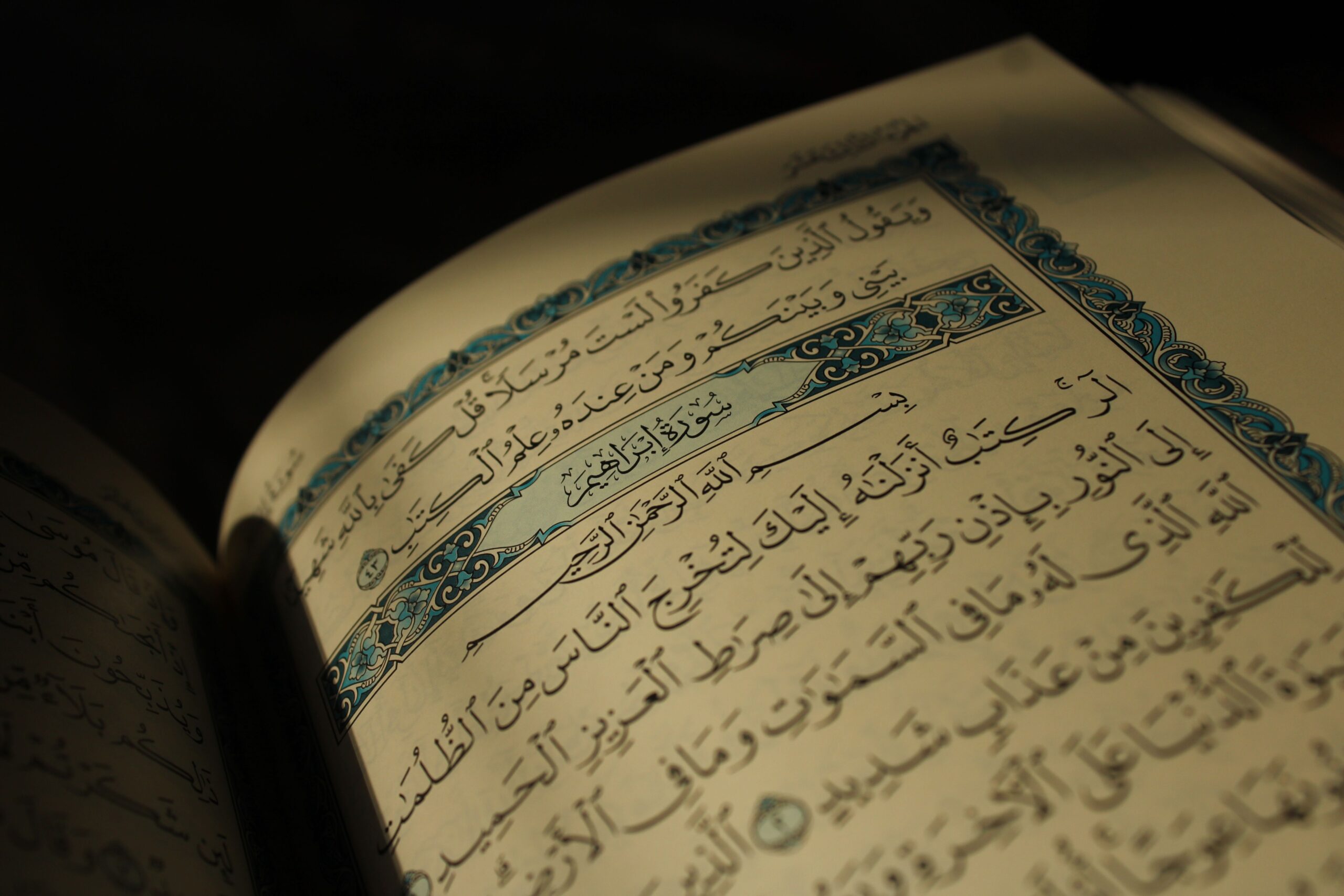
What manner of Book is this!
The Holy Qur’an is the literal Word of God — revealed fourteen centuries ago to an unlettered Prophet of the desert, Muhammad (may peace and blessings of Allah be upon him). And the Word of God cannot contradict the Work of God — this universe and its laws. One Author wrote both, and He does not contradict Himself.
Hazrat Musleh-e-Mau’ud (may Allah be pleased with him) said: “True religion and science can never clash with one another; and if they do appear to clash… either what is being attributed to religion is wrong, or what science is saying — that is wrong.” [Address at the inauguration of the Fazl-e-Umar Research Institute, Qadian, April 19, 1946; Anwar-ul-Uloom, vol. 18, p. 327]
And what does this Book claim to contain? Everything.
The Qur’an declares: “We have sent down to thee the Book to explain everything” [16:90]—and again: “We have left out nothing in the Book.” [6:39]
The Promised Messiah (peace be upon him) said plainly: “It is my faith that the Holy Qur’an is perfect in its teaching, and that there is no verity that has been left out of it.” [Ruhani Khaza’in, vol. 4, pp. 80–81] God told him: اَلْخَيْرُ كُلُّهُ فِي الْقُرْآنِ “all good is contained in the Qur’an.” [Tadhkirah, p. 612; Ruhani Khaza’in, vol. 18, p. 227] He said: “The Qur’an is a casket of jewels, but people are sadly unaware of it.” [Malfuzat, vol. 1, p. 542]
Hazrat Khalifatul-Masih V (may Allah be his Helper) tells us the same: “All new scientific discoveries are also mentioned in the Qur’an … Dr. Professor Abdus Salam … found approximately 700 verses of the Holy Qur’an related to science … It is possible for another Muslim scientist to dive into the vast depths of Qur’anic knowledge and bring out even more pearls of scientific wisdom.” [Friday Sermon, January 2, 2009] Seven hundred verses—nearly one in nine.
Yet the casket has a lock. The Qur’an warns: “None shall touch it except those who are purified.” [56:80] Its jewels are not handed to the merely clever, nor to the arrogant. The key is the prayer of Surah Fatiha we recite in every salat: اِهْدِنَا الصِّرَاطَ الْمُسْتَقِيْمَ “Guide us in the right path” [1:6]—every path, of every science.
Then the Qur’an opens the fundamentals of science. Hazrat Musleh-e-Mau’ud (may Allah be pleased with him) drew them out as three principles. [Address at the inauguration of the Fazl-e-Umar Research Institute, Rabwah, June 25, 1953; Anwar-ul-Uloom, vol. 23, pp. 469–476]
First, everything exists as a compound—in pairs, nothing alone; only Allah is alone. The Qur’an says: “And of everything have We created pairs.” [51:50] Second, there is a ceaseless chain of cause and effect in the universe. The Qur’an says: “Every day He reveals Himself in a different state.” [55:30] Third, to uncover these secrets is our task, and Allah promises to help those who take it up: “As for those who strive in Our path, We will surely guide them in Our ways.” [29:70]
And Allah counts them among the wise and calls them men of understanding: “Those who remember Allah while standing, sitting, and lying on their sides, and ponder over the creation of the heavens and the earth: ‘Our Lord, Thou hast not created this in vain.’” [3:192] So let us reflect a little—upon the small, the near, and upon the far as given in this book.
The Light upon the small and the near
Take a small creature—the honeybee. Listen to the Qur’an:
وَ اَوْحٰى رَبُّكَ اِلَى النَّحْلِ اَنِ اتَّخِذِيْ مِنَ الْجِبَالِ بُيُوْتًا وَّ مِنَ الشَّجَرِ وَ مِمَّا يَعْرِشُوْنَۙ۰۰ ثُمَّ كُلِيْ مِنْ كُلِّ الثَّمَرٰتِ فَاسْلُكِيْ سُبُلَ رَبِّكِ ذُلُلًا١ؕ يَخْرُجُ مِنْۢ بُطُوْنِهَا شَرَابٌ مُّخْتَلِفٌ اَلْوَانُهٗ فِيْهِ شِفَآءٌ لِّلنَّاسِ١ؕ اِنَّ فِيْ ذٰلِكَ لَاٰيَةً لِّقَوْمٍ يَّتَفَكَّرُوْنَ۠۰۰
And thy Lord has inspired the bee, saying, ‘Make thou houses in the hills and in the trees and in the trellises which they build. Then eat of every kind of fruit, and follow the ways of thy Lord that have been made easy for thee.’ There comes forth from their bellies a drink of varying hues. Therein is cure for men. Surely, in that is a Sign for a people who reflect. [16:69–70]
Word by word, these two verses hold truths that science would take centuries to reach.
The word for “trellises,” yarishun, also means a structure built to house small animals—a prophecy that the bee would be given a human-built dwelling. For centuries, European beekeepers kept bees in skeps and often killed the colony while harvesting fixed comb. Langstroth’s movable-frame hive of 1852 made it possible to remove honey without destroying the colony. [U.S. Patent No. 9,300, October 5, 1852] The bees remained free-flying, leaving by day and generally returning by dusk. The next verse says: “Then eat of every kind of fruit.” But bees go to flowers, not fruit—so why “fruit”?
The Qur’an chose the most appropriate word, al-thamarat, the broadest word: all a plant yields—nectar, pollen and resin. Arabic has narrower words, but the Qur’an took the one that gathers them all. The verse continues: “Follow the ways of thy Lord that have been made easy for thee.”
The mechanism by which a bee tells another where the flowers are was not scientifically decoded until the twentieth century. The Austrian zoologist Karl von Frisch decoded the waggle dance—the code by which a forager tells her sisters, in total darkness, the exact direction and distance of the flowers, calibrated against the angle of the sun. He showed that bees do not merely wander; they follow exact, signposted paths—”ways made easy.” His work on animal behaviour helped earn him a share of the 1973 Nobel Prize in Physiology or Medicine. [Nobel Prize in Physiology or Medicine 1973, nobelprize.org] And the verse goes on: “There comes forth from their bellies a drink of varying hues.”
Note the precision even in “from their bellies”: the bee ripens nectar in a special organ, the honey stomach. Honey colour runs from near-white to gold to dark amber, set by the flower source.
Hazrat Khalifatul-Masih I (may Allah be pleased with him) noted that the Arabs had four hundred names for honey. [Badr, February 10, 1910]
And مُّخْتَلِفٌ اَلْوَانُهٗ , “varying hues,” means all the bee produces: not honey alone, but beeswax, royal jelly, propolis, venom and pollen.
Then comes the promise: فِيْهِ شِفَآءٌ لِّلنَّاسِ “Therein is cure for men.” The Promised Messiah (peace be upon him), himself diabetic and taking honey for it, explained why this phrase is honey’s alone: “It is made by the revelation of God… it should not be like other sugary things at all. If it were like these, all sugary things would have been called a cure for mankind; but this has been reserved for honey alone.” [Malfuzat, vol. 4; Al-Badr, vol. 3, pp. 44–45, November 1904]
And science is proving him right. Honey is no simple sugar: alongside its glucose and fructose, it also contains rare sugars—which, far from being harmful, have been found to benefit blood sugar control, and are now being studied against diabetes itself.
Perhaps the cure he sought lies within the words فِيْهِ شِفَآءٌ لِّلنَّاسِ: inside honey is shifa—cure. But the Qur’an also adds, “in that is a Sign for a people who reflect”—giving the clue and leaving the research to us. Here I speak as a scientist: we have started to see evidence of honey’s antibacterial actions and its ability to support wound healing. But the deep system the Qur’an points to, we have not yet found. Hazrat Khalifatul-Masih IV (may Allah have mercy on him) said as much: the Qur’an would not name a thing a cure for mankind without a deep system within it, yet “man has not yet discovered this system.” He warned: “Do not leave this research to the non-Muslims.” [Homeopathy Class 115, October 17, 1995; Friday Sermon, March 31, 2000]
Hazrat Khalifatul-Masih III (may Allah have mercy on him) said that this one verse has handed us a billion dollars’ worth of research. [Friday Sermon, March 19, 1982; Khutbat-e-Nasir, vol. 9, pp. 409–418] Perhaps its fullest cure waits for the age of the ascendancy of the Ahmadiyya Jama’at. The Promised Messiah (peace be upon him) hinted at this: “The [definite]al placed upon [people]nas shows that the healing is for those who are His own servants—who strive and discipline themselves to draw near to Him—for Allah the Exalted has always favoured the elect (khawas); what concern has He with the common?” [Malfuzat, vol. 6, p. 43; Al-Badr, February 16, 1904] So two verses, revealed in seventh-century Arabia, encode the bee’s nesting and human-built hives, its foraging and its language, the chemistry of its product and the medicine within it—and each word is still giving us new discoveries.
Diet and nutrition
The Qur’an unravels nutrition too. Over all foods stands one law. The Qur’an commands: “Eat and drink, but exceed not the bounds” [7:32]—what we now call the balanced diet. In The Philosophy of the Teachings of Islam, the Promised Messiah (peace be upon him) explains that food shapes character: an all-plant diet weakens courage, an all-meat diet weakens humility—the middle course builds both. [The Philosophy of the Teachings of Islam, pp. 8–10] He went further than the physical and intellectual effects of food, showing that it has moral effects too. Of fasting, the Qur’an says: “Fasting is good for you, if you only knew.” [2:185]
In 2016, Yoshinori Ohsumi won the Nobel Prize for autophagy—the body’s self-cleaning, which fasting can switch on. [Nobel Prize in Physiology or Medicine 2016, nobelprize.org]
A small verse can hold a whole field of science. Surah Luqman commands: وَ اقْصِدْ فِيْ مَشْيِكَ —”Walk thou at a moderate pace” [31:20; The Philosophy of the Teachings of Islam, p. 37]—four words that seventy years of exercise research now confirms. The epidemiologist Jeremy Morris proved it on London’s buses: the stair-climbing conductors suffered far less heart disease than the seated drivers.
Walking, he wrote, is “the nearest activity to perfect exercise.” [Morris and Hardman, Sports Medicine, 1997;23:306–332] Nowadays, people aim to walk 10,000 steps a day. The Promised Messiah (peace be upon him) also walked regularly—past seventy years of age, carrying several illnesses—four, five, even seven miles. [Friday Sermon, July 22, 2016, alislam.org; Al Hakam, March 18, 2022]
Let me take you a step further. The precision of the words used by the Qur’an gives us the very foundation of sports science. The Qur’an in the phrase waqsid fi mashyka regulates مَشْي (mashy)—in Imam Raghib’s classical definition, moving from one place to another under one’s own power and volition.
And it commands قَصْد (qasd) in it: an aimed, measured, middle pace—neither sluggish nor racing. Sports science has rediscovered exactly this pace and calls it “endurance or zone two”—the conversational effort at which the body learns to burn fat, multiplies its mitochondria—its power-plants—and lays the foundation of all endurance sports. Olympic marathon runners and Tour de France cyclists spend most of their training hours at precisely this easy pace. It is fitting, then, that Hazrat Khalifatul-Masih III (may Allah have mercy on him) urged Ahmadis to cycle a hundred miles—160 kilometres—in a day: a distance no one covers except through long, steady hours at that moderate, measured zone-2 pace.
Even our rest is by design. The Qur’an says: “We have made your sleep for rest, and made the night as a covering.” [78:10–11] In nearly every cell ticks a clock, tuned to day and night. The 2017 Nobel Prize went to Hall, Rosbash and Young for laying bare this biological time-clock. [Nobel Prize in Physiology or Medicine 2017, nobelprize.org] The darkness of the night is a covering: the body releases hormones of sleep, cools, and turns to repair. Break this rhythm—shift-work, night labour, screens after dark—and disrupted sleep follows, bringing obesity, diabetes, heart disease, even cancer.
It was in these rest hours, when alertness is weakest, that Chernobyl, Bhopal and the Exxon Valdez disasters struck. What the Qur’an set in a phrase, science is only now catching up.
The Light upon the far
Now let us lift our eyes to the skies, and the same fundamentals appear with the same precision.
The Qur’an told a desert people: “He it is Who made the sun radiate a brilliant light and the moon reflect a lustre” [10:6]—nothing in the desert sky could teach that.
It told them sun and moon each keep an appointed course, stating: “All of them float in an orbit.” [36:41] And it told them: “You see the mountains, imagining them to be stationary, while they are floating like the floating of the clouds” [27:89]—a sentence we did not grasp until the last century.
Then we learned the continents are drifting on their tectonic plates. One of the men who proved it was a Canadian—J. Tuzo Wilson, a professor at the University of Toronto. [University of Toronto Magazine, September 6, 2001]
Everything in pairs, everything in motion, everything by measure—exactly as the Qur’an declared. This is why the universe can be studied at all. And the scientist who studies it, whether he knows it or not, is reading the second Book of God—the Work of God.
Why they walk one step ahead of us
But there is a question we face. If all these truths are laid open in this Book, why do those who do not even believe in it make the discoveries? A fair question—and the Qur’an answers it.
Progress rides on two wheels, joined in one verse of the Fatihah, recited in every prayer: اِيَّاكَ نَعْبُدُ وَ اِيَّاكَ نَسْتَعِيْنُ—“Thee alone do we worship, and Thee alone do we implore for help.” [1:5] The first wheel is human labour; the second is the help of God, sought in prayer.
The disbeliever has seized the first wheel of effort and ignored the second wheel of trust in Allah and prayer. This one wheel moves — slowly, with enormous effort, at great risk of a fall. Even that is mercy: God withholds His bounty from no one, not even those who never ask. The believer who labours just as hard, and adds trust and prayer, rides on both wheels—and flies past like one on an aero road bike: the same two legs, at least four times the speed. The Promised Messiah (peace be upon him) taught that the very pondering of a scientist — reaching with his whole mind for an answer he cannot yet see — is itself a kind of prayer.“The key to every house of knowledge,” he wrote in Ayyam-us-Sulh, “is prayer.” [Ayyam-us-Sulh; Ruhani Khaza’in, vol. 14, pp. 229–230]
But the prayer of a man veiled from God is blind: it comes dressed as reflection, as the search for material causes; it stretches a hand toward the Source of Grace — without knowing Him. The one-wheeled rider, too, is asking — he just does not know at whose door. The believer knows, and his research, done rightly, becomes worship. For Allah has promised: “As for those who strive in Our path, We will surely guide them in Our ways.” [29:70]
But the second wheel of prayer does not excuse us from the first: hard work. Every great scientist has made the day and the night one in his or her pursuit. We cannot offer God a lazy effort and ask Him for results — we must out-labour our rivals, and out-pray them. Then the difference will show. The disbeliever’s ship drifts on a dark sea—a wave may throw a fish on deck, but he cannot see the rocks jutting out ahead. The believer sails the same ocean, brightly lit by the Sun of the Qur’an: wherever he casts his net, he draws it up full of fish.
This is the future of scientific discovery that the Holy Qur’an promises.
The vista ahead
How far ahead does this Book see? Further than our instruments—from the universe’s beginning to its end.
The Qur’an asks: “Do not the disbelievers see that the heavens and the earth were a closed-up mass, then We opened them out?” [21:31]—what we now call the Big Bang. Of the heaven it says: “And the heaven We built with Our own powers, and indeed We go on expanding it.” [51:48, tr. Revelation, Rationality, Knowledge and Truth, p. 303] Written thirteen centuries before Edwin Hubble observed that galaxies fly apart in 1929. [Hubble, Proc Natl Acad Sci USA, 1929;15:168–173]
The Qur’an then declares that we are not alone in the universe. It states: “Among His Signs is the creation of the heavens and the earth, and of whatever living creatures He has spread forth in both. And He has the power to gather them together when He pleases.” [42:30] It promises that we shall one day establish communion with extraterrestrial life. [Hazrat Khalifatul-Masih IV (may Allah have mercy on him), Revelation, Rationality, Knowledge and Truth, pp. 333–334] The Qur’an points further — to sciences not yet born, some that man has only begun to fear.
It warned that men would one day “alter Allah’s creation” [4:120] —and now we edit the gene. And it keeps pointing.
At matter built in new ways—wings “two, three, and four; He adds to His creation whatever He pleases.” [35:2]
At bodies of new material—”Be ye stones or iron, or created matter of any kind which appears hardest in your minds.” [17:51–52]
At creation itself remade—”If He please, He can do away with you, and bring a new creation.” [14:20]
And at the folding-up of the cosmos itself: “The day when We shall roll up the heavens like the rolling up of written scrolls by a scribe.” [21:105]
I do not say we have proven these things. I say the Book has presented them before us, and science walks toward them one discovery at a time. Let us take the Qur’an as our guide, and we shall reach these discoveries much sooner—on a brightly lit road, not stumbling in the dark.
To the young who will carry this
And so, before I close, I turn to the young Ahmadis before me — those who will enter the universities of this country. We are not here to match the world; we are here to become its teachers — in religious and in scientific knowledge both. We hold a Book they do not have; it opens doors for us that are permanently closed for others. Never imagine any door of scientific pursuit is closed, nor limit your imagination: only what Allah has declared impossible is impossible; what man declares impossible is not.
And do not imagine that science means only the laboratory. The conviction that gave Islam Ibn al-Haytham—who gave mankind the scientific method—also gave it Ibn Khaldun, who carried that method into history and society and founded the social sciences. Medicine, law, economics and history—before us lie unlimited oceans of inquiry. The Qur’an declares: “If all the trees that are in the earth were pens, and the ocean were ink, with seven oceans swelling it thereafter, the words of Allah would not be exhausted.” [31:28] The Promised Messiah (peace be upon him) alluded to this: study a single leaf for a thousand years, and the years would end before its wonders did—” because whatever has come into being from infinite Power must necessarily contain infinite wonders and properties within it.” [Karamat-us-Sadiqin; Ruhani Khaza’in, vol. 7, p. 60]
I confess, I feel goosebumps at the scientific truths the Qur’an promises: our discoveries will not be confined to the earth, but will reach into the cosmos. Of that verse of al-Anbiya, the Promised Messiah (peace be upon him) wrote: “The heavens and the earth were both like a closed mass whose substance and secrets were hidden, and We cleft them both”—meaning that one nation would advance the earthly sciences, and after it another would be raised, “for whom the gates of heaven have been opened.” [Arbain, no. 2; Ruhani Khaza’in, vol. 17, p. 367; English: Arbain Number 2, pp. 34–35] And the Qur’an promises that day: “And the heaven shall be opened and shall become all doors” [78:20] —perhaps indicating true long-distance space travel.
And how much heaven there is to open! The Qur’an states: “Allah is He Who created seven heavens, and of the earth the like thereof.” [65:13] In Surah al-Saffat it states: “We have adorned the lowest heaven with an adornment of stars.” [37:7] Referring to the lowest heaven, Hazrat Khalifatul-Masih III (may Allah have mercy on him) said in 1980 that whatever we have reached through our instruments, where stars reside, is just the lowest heaven. “Beyond it there are six more heavens. So when man reaches those places, the inner light of the Holy Qur’an will illuminate human reason there also.” [Friday Sermon, April 25, 1980; Khutbat-e-Nasir, vol. 8, p. 603]
In fact, that day is not far. In the first sermon of the second century of Ahmadiyyat in 1989, Hazrat Khalifatul-Masih IV (may Allah have mercy on him) declared: “If the earth runs out of room for your spread, the God of this century will grant you expansion in the asman [in space itself], and room upon room shall be made in those heavens for your spread.” [Friday Sermon, March 24, 1989; Khutbat-e-Tahir, vol. 8, p. 187]
The charge
My dear brothers, let me leave you with an irony. Hazrat Khalifatul-Masih IV (may Allah have mercy on him) said: “Don’t leave every investigation to the non-believers in the Holy Qur’an … This is an irony of fate for us—that we are told the secrets of life, and those who do not read this Book, do not believe in this Book, always go one step ahead of us, and tell us what the Holy Qur’an has been telling us all along.” [Question and Answer Session, January 10, 1986] We hold the casket—and stand by while strangers find the jewels.
Let it not be so. The Promised Messiah (peace be upon him) told us that this age needs not the sword but the pen—that he was sent into the battlefield of science armed with it, to show the world the inner strength of Islam. Let us take up that pen. Study this Qur’an with deep contemplation; hold it dearer than anything you own. For a Day is coming when this Qur’an will be set before all mankind, and they will cry: “What kind of a Book is this! It leaves out nothing small or great but has recorded it.” [18:50]
So before this Jalsa ends, I ask of every young Ahmadi here one commitment: choose knowledge, and pursue it to its height. Whatever your field, take it to its highest degree — and take the Qur’an with you. Become the scholars of this Jama’at—at every level, in every field. Keep the Holy Qur’an as your guide, and no power on earth can defeat you. The discoveries to come will stand like mountains, and our era a molehill beside them—until the day dawns that the Qur’an has described as “a spectacle of bliss, and a vast kingdom.” [76:21, tr. Sir Muhammad Zafrulla Khan]
May Allah make us, and our children, the people who read and ponder over His Word and His Work with the same eyes, and find in both the same One God; and may He bring back, through us, the lost glory of the Islamic Golden Age. Ameen!